Showing posts with label holiday. Show all posts

Victoria Day Food History


1854 Celebration of Queen Victoria's birthday on the grounds of the second Government House of Upper Canada, Toronto.

For Canadians, Victoria Day (or May 24 [pronounced two-four, also slang for a case of 24 beers]) is an important celebration which generally marks the unofficial beginning of summer. Victoria Day occurs on the Monday before May 25th and forms the third day of a long weekend. So although we refer to it as May 24, Victoria Day can actually fall on any date between the 18th and 24th of May. This year we celebrate on the 19th.

However, as the name might suggest, in the beginning Victoria Day wasn't exactly meant to signify the beginning of summer. May 24, 1819 happens to be the birthday of Queen Victoria. Celebrations of the Queen's birthday had occurred in Canada since before it was actually a country. These celebrations were usually on the actual date of May 24th. In 1845 (22 years before Confederation) the parliament of the Province of Canada passed legislation which officially recognized the date of the Queen's birthday as a holiday. By the 1890s Victoria Day had turned into quite the festive occasion, complete with ringing church bells, marching bands, parades, picnics, fireworks, gun salutes, athletic competitions, and bonfires.

Following Victoria's death in 1901, the birthday of her son, Edward VII, was also celebrated on May 24th, despite his being born in November. The next sovereign, George V, had his birthday officially celebrated on June 3rd, which was indeed his real birth date. Though he only ruled for a year, Edward VIII had his birthday celebrated once on the actual date, June 23rd. The next monarch, George VI, officially celebrated his birthday in June as well, despite being born in December. For her first birthday as Queen, Elizabeth II continued the tradition of celebrating her birthday in June, although she was born in April. Meanwhile, Canadians had continued to celebrate Victoria Day in May. Canadians had maintained a fondness for the "Mother of Confederation," who had overseen the rule of Canada as it came to maturity as its own nation. Perhaps this is why, in the second year of her reign (1953), Queen Victoria's birthday was, by proclamation, to be celebrated on Victoria Day. Although Queen Elizabeth II's birthday is still celebrated in June in the United Kingdom, in 1957 Canada officially and permanently appointed Victoria Day as Elizabeth II's birthday as well. To make matters more confusing, in 1898, Empire Day was first celebrated in Canada on the school day before May 24th, thus building upon the celebrations of Victoria Day to glorify Canada's ties to the British Empire. In 1952, Empire Day was moved to the Monday before May 24th, and the year after, Victoria Day was moved to the same date, thus merging the two holidays. However, in 1958 Empire Day was renamed Commonwealth Day and in 1977 it was once again moved, this time to the second Monday in March. This left Victoria Day/Elizabeth II's birthday on the Monday before May 24th, as the statutory holiday we celebrate today.

The Lewiston Daily Sun - May 3, 1901

Today Victoria Day contains many of the same activities - mainly picnics, parades, and fireworks - as well as some more modern additions. The long weekend is when Canadians can open up their dusty cottages after the winter, start gardening, go camping, boating, or maybe even risk a swim (though the water may be quite chilly). The beverage of choice is two-fours of ice cold beer and barbecues will be fired up once again. Many people take advantage of the time off to party. Some people may even still recite the old rhyme, "The Twenty-Fourth of May is the Queen’s Birthday. If we don’t get a holiday, we’ll all run away!"

So what, then, do Canadians eat on Victoria Day? I tried to answer this question, and here's what I found from newspaper advertisements (mostly from grocers advertising foods for the holiday) and a few cookbooks:
  • "families would char hotdogs or burn hamburgers over an open fire. It was fishing time, too, with sleek pickerel...smelt...and suckers..." Gadsden Times - May 13, 1975
  • Creole Wieners and Oriental Spice Cake with Mocha Icing. Ottawa Citizen - May 17, 1956
  • Sliced cold turkey. Ottawa Citizen - May 18, 1967
  • Potted meats, potted fish, potted game, lunch tongue, boneless chicken, boneless turkey, chipped beef, pate de fois, truffled birds, cottage loaf, ham loaf, beef loaf, fruit wines and ciders, fruit syrups, lime juice. Ottawa Citizen - May 22, 1901
  • Oranges, olives, dates, prunes, butter scotch, Welch's grape juice. The Montreal Gazette - May 21, 1912
  • Sandwiches, salads. The Montreal Gazette - May 23, 1941
  • Domestic ducks, roasting chickens, squabs, broilers, brome lake ducklings. The Montreal Gazette - May 23, 1941
  • Roast ham, boiled ham, corned beef, pressed ham, jellied tongue, jellied veal, jellied hock, english brawn, pickles. Ottawa Citizen - May 22, 1913
  • Asparagus soup, roast lamb, minted peas and carrots, rissole potatoes, relish tray, chutney, rhubarb custard pie. Chatelaine's Adventures in Cooking, 1969
  • Devilled eggs, pan-fried minted brook trout, cheese herb bread with sweet butter, spring salad, Fullarton May cakes with fudge icing, classic butter tarts, chilled dry white wine, cold lager beer. Classic Canadian Cooking, 1974

Sources:

"Commonwealth Day." Wikipedia. Wikimedia Foundation, 05 Nov. 2014. Web. 14 May 2014. <http://en.wikipedia.org/wiki/Commonwealth_Day>.

Toffoli, Garry. "The Queen’s Birthday in Canada." Canadian Royal Heritage Trust. N.p., 2013. Web. 14 May 2014. <http://crht.ca/the-queens-birthday-in-canada/>.

"Victoria Day." Canadian Heritage. Government of Canada, 2013. Web. 14 May 2014. <http://www.pch.gc.ca/eng/1359139714709/1359139936142>.

"Victoria Day." Wikipedia. Wikimedia Foundation, 05 Nov. 2014. Web. 14 May 2014. <http://en.wikipedia.org/wiki/Victoria_Day>.

"Victoria Day in Canada." Time and Date. N.p., n.d. Web. 14 May 2014. <http://www.timeanddate.com/holidays/canada/victoria-day>.

"Victoria Day: Responsible Rule and Firecrackers." The Globe and Mail. N.p., 18 June 2012. Web. 14 May 2014. <http://www.theglobeandmail.com/globe-debate/editorials/victoria-day-responsible-rule-and-firecrackers/article4197794/>.

St. Patrick's Day Party (c. 1931)

I love that The Settlement Cook Book includes holiday menus like this one for a Saint Patrick's Day party. Its rather rare to find menus like this in early cookbooks, especially for something other than Christmas. The theme here seems to be green + mint - not so different from a menu we might see today! There is also an emphasis on potatoes and shamrocks, two items which have continued to symbolize Irish heritage even today.


Recipes for Red Hots (1929-1972)

Still hanging on to those spicy cinnamon hearts from Valentine's? Also known as Red Hots (brand name) or cinnamon imperials (generic name), cinnamon hearts hold a fond place in my childhood memory. As a child I often accompanied my mother on long car trips, so there was nearly always some sort of candy or snack close at hand. Around Valentine's Day, cinnamon hearts made an appearance, and I can still recall the addictive, spicy sting of their flavour on my tongue. This year, Mr. Man brought some home for me, but oddly I found that I couldn't quite tolerate the flavour as much as I could when I was younger. I wondered if I could find some strange historical recipe so that I could use them up rather than waste them. Amazingly, recipes using cinnamon candies date back to at least 1929, which was before the Red Hots brand was trademarked. These candies are almost always paired with apple(sauce) and/or Jell-O, and often seems to hold a special place on holiday tables, as a symbol of family heritage and tradition.

So, compiled for your convenience, some recipes using cinnamon heart candies:

Applesauce with red hots 

From: Better Homes and Gardens Junior Cook Book (1963)
Source


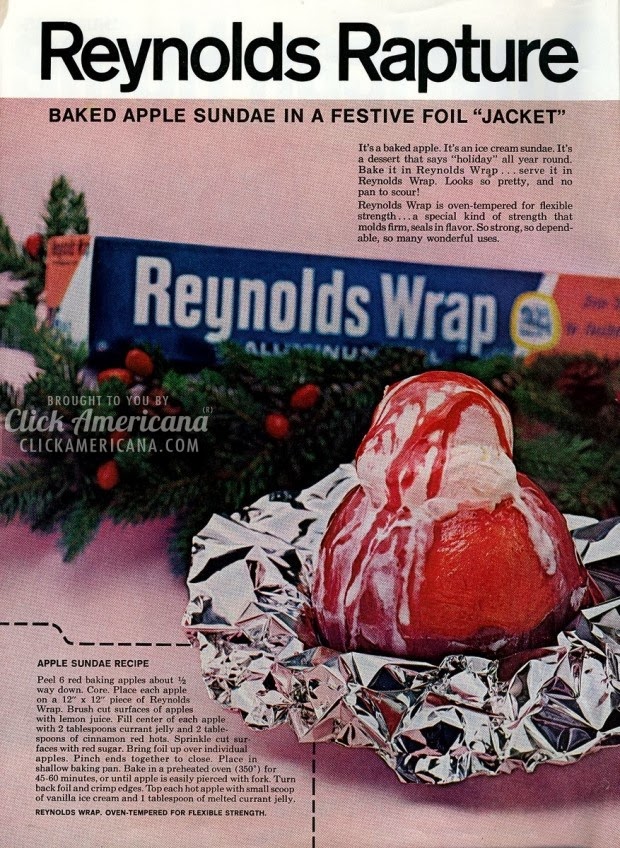
Apple Sundae

From: Reynolds Wrap advertisement (1972)
Source


Imperial Salad/Cinnamon Apple Salad

From: The Parker Cook Book (1932), updated by Laura Gutschke
Source

IMPERIAL SALAD
Cox's cinnamon apple salad called for an usual mix of ingredients that includes cottage cheese, walnuts and red cinnamon candies, famously known as Red Hots. (Another generic name for the candy is cinnamon imperials.) Surprisingly, they work well together.
The candy's intense cinnamon flavor reduces to a subtle hint when cooked in the sugar syrup in the following recipe.
The original instructions called for cooking cored apples whole in the red syrup and stuffing them with a mixture of cottage cheese and walnuts. I instead sliced the apples. I also eliminated the lettuce and mayonnaise that was included in the serving directions.
The apples also can be enjoyed without the cottage cheese.
CINNAMON APPLE SALAD
Ingredients
1/2 cup sugar1/2 cup water
1 cup red cinnamon candies
4 crisp apples, sliced
Cottage cheese
Chopped walnuts
Directions
1. In skillet, cook sugar, water and cinnamon candies over medium-high heat to make a syrup. Stir often to blend well.
2. Add apple slices to the syrup mixture and reduce heat to medium. Cook until apples are tender but not broken, about 10 to 15 minutes. Gently stir occasionally.
3. Remove cooked apples from syrup and place slices skin side down on serving platter. Chill in refrigerator about one hour.
4. In a separate bowl, mix about 2 tablespoons walnuts into 1/2 cup cottage cheese for each serving.
5. Place 5-6 apple slices on a plate and top with serving of cottage cheese mixture.


Applesauce Salad

From: Recipe collection, undated
Source


Cinnamon Candy Jell-O Salad

From: unknown (1961)
Source
1 pkg. Cherry Jello
1/4 C. cinnamon candies (Red Hots)
1 C. hot water
2 C. applesauce
Dissolve candies in hot water and add Jello. Stir into applesauce and chill.


Cinnamon Apple Salad Dessert

From: The Evening Independent (1929)
Source


Blushing Snowballs

From: Westinghouse recipe pamphlet (1950s)
Source


Alphabet Pie 

From: 250 Superb Pies and Pastries, Culinary Arts Institute (1941)
Source

Cinnamon Creme

From: Eugene Register-Guard (1959)
Source


Washington's Birthday Luncheon (c.1931)

Unless you're a new reader, you might already know that I'm Canadian. But I get a kick out of American holidays too! That's probably because I've spent a few years living there - in California for a year and later in Ohio for 4 years. So yes, Presidents' Day is today! Also called Washington's Birthday. If you want to get all festive and historical, try out this 1930s menu for a luncheon from The Settlement Cook Book! I've also done the work of finding the referenced recipes, so they're also included below the menu itself.

Original Recipe:


 So let's break down this menu.

Orange halves with maraschino cherries: Washington is often associated with cherries, and while some "cherry tree chopping" story has been debunked as myth, he did apparently like to eat the fruit.

Chicken a la Maryland: I'm not really sure where they're going with this one, as Washington is well-known to have been very fond of fish, not chicken.

Southern Sweet Potatoes: I'd guess this is a nod to Washington's southern heritage.

Virginia Corn Bread: There was no such recipe, but there were recipes for plain old "Cornbread." Since Washington was born in Virginia and lived there at Mt. Vernon, I assume this is a convenient re-naming.

Cherry Salad: Again, the association of Washington with cherries. I found it interesting that this recipe actually specifies in the instructions that it is good for celebrating his birthday.

Boston Brown Bread: Boston is a place that is really steeped in American heritage. During the American Revolution, Washington forced the British out of Boston, which saved the city from an ongoing siege.

Chocolate Roll: Again, this seems like an odd choice. Why not Washington Cake?!?! I mean, really...It's an obvious choice...

Nuts, Raisins, Coffee: GW apparently loved nuts, especially hazelnuts and shellbacks (similar to pecans).

If you're extra curious, there's lots more information on what Washington and other Presidents liked to eat here!

New Year's Wish (1966)

Here's a New Year's tradition that sounds really fun...


...And also a bit gross.
Charred paper anyone?

From The Chatelaine Cookbook.

Maple Velvet (c. 1930) ★★★★★


Just a quick and simple recipe today! I couldn't find much history on it, except for two mentions of the recipe in newspapers. The first was in the Bolivar Breeze, October 9, 1947 (New York) and the second was printed in the Freeport Journal-Standard on November 13, 1947 (Illinois). The first suggests the recipe as a party drink for Halloween. In that case, it seems I'm three days too late, whoops!
Its possible this recipe may have been making the newspaper rounds in the mid 1940s. I'm not sure when this Canada Dry pamphlet I found the recipe in was printed, but we can definitively conclude that it wasn't any later than 1947!

Original Recipe:


Maple Velvet
Service for 1
In a tall glass place two tablespoons of pure maple syrup. Add a generous helping of vanilla ice cream. Fill the glass with ice cold Canada Dry and stir until well mixed.


The Verdict:

I don't really know what else to say except that this was freaking amazingly delicious! I've always been so-so about ice cream floats, but I'm in love with this. I felt like none of the flavours were overpowering and instead they all worked together really well. The addition of maple syrup was genius, and I think this wouldn't be as good if it was just ginger ale and ice cream. I hadn't ever heard of this recipe before, but I wish I had. I think this really could have been a great candidate for a Canadian classic, given the use of maple syrup and Canada Dry. 

Modernized Recipe:


2 tablespoons PURE MAPLE SYRUP
1 large scoop VANILLA ICE CREAM
GINGER ALE to fill the glass

1. Pour the maple syrup into a tall glass. Add the ice cream and fill with ginger ale. Stir to mix well. Drink and enjoy!

The Food History of Labour Day

Eight Hour Day Banner, Melbourne, 1856

Labour Day is an important annual holiday in North America. Labour Day, which falls on the first Monday in September, signifies the end of summer and return to school, but its origins lie in the 19th century worker's rights movement. In North America, Labour Day can be traced back to a Canadian union strike parade in 1872. In Canada, unionization was considered a crime at the time, so when the parade prompted Prime Minister John A. Macdonald to promise to repeal the anti-union laws, a celebration followed and became an annual tradition. In Canada celebrations were held in the spring, but similar events in the United States led to an American holiday in September, so in 1894 Canadian Prime Minister John Thompson declared that Labour Day would officially be in September in Canada as well.

In other countries, Labour Day is celebrated on different days, often May 1st, which is International Worker's Day. In Australia Labour Day occurs in October, March, or May, depending on the province. New Zealand holds celebrations in October. In the Bahamas Labour Day is celebrated in June, while in Jamaica the date is set in May. Trinidad and Tobago officially celebration Labour Day in June.

Because Labour Day is considered the end of summer, it offers a last chance for summer activities, such as picnics, beach trips, and barbeques. Therefore traditional Labour Day food is often associated with these events. An advertisement from the August 17, 1969 Los Angeles Times names ham as the "perfect Labor Day dinner":

"For a perfect Labor Day dinner, Fabulous Spiral Sliced Honey Baked Ham (so good it will Haunt you til it's Great!)...because we planned it that way. By using only fresh hams from Iowa's corn-fed porkers--our slow dry curing method, real Wisconsin hickory and applewood smoking, 30-hour oven baking, honey 'n spice glazed. So delicious and appetizing we just wouldn't know how to improve this product we've been making for the past 34 years. Spiral sliced too, from top to bottom for easy removal of slices, yet retains 'whole ham' appearance for serving. Every slice the same delectable thickness. Completely baked and ready to serve. Order you Honey Baked Ham today. An adventure in hamjoyment you'll never forget. Three sizes: aprx. 11 lbs, $16.50; aprx. 12 lbs, $18.00; aprx 13 lbs, $19.50." 

Another meat product associated with Labour Day is the hot dog, according to Nate Rawlings:

"Americans eat a lot of hot dogs. According to the National Hot Dog and Sausage Council, during "hot dog season," which runs from Memorial Day to Labor Day, Americans consume roughly 7 billion hot dogs, or about 818 hot dogs every second...There're several amazing things here. First, the fact that Americans consume such an incredible amount of hot dogs. Second, that there is a hot-dog season. And finally, that there is a National Hot Dog and Sausage Council."
A Labour Day parade in Toronto, Canada, 1900

On September 2, 1954, the Edmonton Journal, Ottawa Citizen, The Leader-Post, and the Vancouver Sun all included recipes for a "Labour Day Backyard Barbecue," featuring hamburgers and homemade doughnuts. Below the column was a recipe for peach cobbler, which was unrelated but still seems like an appropriate seasonal recipe.

Another newspaper advertisement from the September 1, 1950 Greensburg Daily names ham, weiners, chuck roast, bacon, pork loin roast, cheese, potato chips, pretzels, and a variety of other foods to meet "all your needs for the Labor Day Weekend."

Lastly, I'd like to highlight a very early source, published in The Bakersfield Californian in 1907. This article shows that by the early 1900s, barbecues had already become a standard Labour Day activity. Other celebrations included horse racing, a parade, speeches, "novelty events", music, and dancing. And of course, the specifics about the barbecue:

"At noon time a great barbecue will be served at the park, this, like everything else in the day's entertainment, being free to holders of the entrance ticket, in the form of a tag. Joe Yancey and Joe Mackey have this most important feature of the day's entertainment in charge, and promise that the hungry public shall be fed bountifully. Beef will be roasted in the good old Spanish style, and there will be plenty of other eatables in sight."
So, with that, if you're celebrating Labour Day today, enjoy the day off and plenty of "eatables!"

Mint Julep (1917) ★★★★★

Today, Mint juleps are very closely associated with the Kentucky Derby, which runs on the first Saturday in May. This year, 2013, the event falls on May 4th.

As with nearly any recipe, it is difficult to pin an exact date when the mint julep was created. Currently, the first known mention of the drink is in the 1803 book Travels of Four Years and a Half in the United States of America by John Davis. The reference appears in a passage called "Story of Dick the Negro" and states, "This young chap, Sir, (here Dick winked his left eye,) was a trimmer. The first thing he did on getting out of bed was to call for a Julep;* and I honestly date my own love of whiskey, from mixing and tasting my young master's Juleps." The footnote reads, "A dram of spirituous liquor that has mint steeped in it, taken  by Virginians of a morning."  In Kentucky, silver julep cups were being awarded as fair prizes as early as 1816.

The origins of the term "julep" can be traced to a Middle Eastern beverage of rose petals muddled in water, called a "gulab" or "julab." "Julep" is a French translation. The Oxford English Dictionary cites the earliest use of the word as around 1400, when it was used to describe a syrup used to administer medicine. This method of improving the flavour of water eventually made its way to the Americas, and apparently evolved along the way. One theory is that the mint julep was created in order to mask the flavour of poorly made whiskey - similar to the original use of a medicinal julep.

Naturally, such a popular beverage did not arise without argument. The main issue is whether to crush the mint or not. This debate dates back to the earliest incarnations of the drink in the nineteenth century. Furthermore, there is a bit of a rivalry between Kentucky and Virginia, as to who can claim ownership of the beverage.
LIFE, May 1937
The association of the drink with the Kentucky Derby began in 1875, with the inception of the racetrack. It was first advertised as the official Derby drink at Churchill Downs in 1938. An 1937 edition of LIFE magazine included details of Julian P. Van Winkles' "mint julep party" held during that years Kentucky Derby. Apparently the Van Winkle recipe for mint juleps used only 17 year old bourbon. The recipe LIFE provided was: "put sugar and bruised mint at the bottom of the silver cup, pack in finely-cracked ice to induce proper frosting, stick mint sprigs in after two ounces of Bourbon have been poured." Today hundreds of thousands of juleps are served at the Derby and collectible cups have been soldd since 1938.

While mint juleps are traditionally alcoholic, this recipe is safe for the whole family! It may not be authentic, but it hits the spot when you can't or don't drink alcohol. It is possible that this unusual 1917 recipe was a result of the prohibition movement. Temperance, or abstinence from drinking alcohol, had gained momentum during the nineteenth century, and  by the early twentieth century laws were being passed which prohibited the sale of alcohol, partially in order to save resources for World War One. The Eighteenth Amendment in the United States took effect in 1920 and prohibited the sale, transport, and production of alcohol. (Fun fact: here in Ontario we can only buy alcohol from LCBO [Liquor Control Board of Ontario] stores, a remnant method of control in the post-prohibition era.)
LIFE, August 1941
For those wishing to imbibe in the traditional version, here is an early printing of the recipe, from 1845. It was published in Eliza Acton's Modern Cookery for Private Families in Britain:

Mint Julep, An American Receipt.
Strip the tender leaves of mint into a tumbler, and add to them as much wine brandy, or any other spirit, as you wish to take. Put some pounded ice into a second tumbler; pour this on the mint and brandy, and continue to pour the mixture from one tumbler to the other until the whole is sufficently impregnated with the flavour of the mint, which is extracted by the particles of the ice coming into brisk contact when changed from one vessle to the other. Now place the glass in a larger one, containing pounded ice: on taking it out of which it will be covered with frost-work.' Obs.--We apprehend that this preparation is, like most other iced American beverages, to be imbibed through a reed: the recei, which was contributed by an American gentleman, is somewhat vague.
Alternatively, you could try Henry Watterson's recipe: "Pluck the mint gently from its bed, just as the dew of the evening is about to form upon it. Select the choicer sprigs only, but do not rinse them. Prepare the simple syrup and measure out a half-tumbler of whiskey. Pour the whiskey into a well-frosted silver cup, throw the other ingredients away and drink the whiskey."


Original Recipe:

25.—MINT JULEP (Ginger Ale)

¾ cup sugar4 sprigs mint
1 cup water1 pint ginger ale
Juice of 3 lemons
Boil sugar and water ten minutes, and cool; add strained lemon juice, mint leaves bruised, and ginger ale; half fill glasses with crushed ice, add julep, and garnish with a sprig of mint.


The Verdict:
This drink basically tastes like sweet, lemony mint tea. I enjoyed it. The ginger ale wasn't really tasteable, but it gave a nice fizz. It was definitely refreshing. The drink alone is quite sweet, so it definitely needs the ice (or even just water if need be) to dilute it a bit. While it was definitely a delicious recipe, I'm not sure it actually resembles a real mint julep at all.

Modernized Recipe:
(Adapted from Better Meals for Less Money)

3/4 cup SUGAR
1 cup WATER
Juice of 3 LEMONS, strained
4 sprigs MINT, plus more for garnishing
1 pint (2 cups) GINGER ALE
CRUSHED ICE

1. In a small saucepan, boil the sugar and water for 10 minutes. Let cool.
2. Add the lemon juice to the cooled sugar syrup. Add the mint leaves, and gently bruise them by pressing on them with the back of a spoon (or use a muddler). Add the ginger ale.*
3. Fill glasses with crushed ice, add the julep, and garnish with a sprig of mint.

* Although the recipe didn't mention this, I strained the syrup before adding the ginger ale. I used frozen mint leaves (a mistake, I might add), so they were all shriveled and nasty and I didn't want them in my cup.

Also note, I've read a recipe in which the mint leaves are muddled in hot water, in order to bring out the flavour. It might be worth it to add them to the hot syrup to mimic this method.


-----
Sources

Davis, John. Travels of Four Years and a Half in the United States of America during 1798, 1799, 1800, 1801, and 1802. Bristol: R. Edwards, 1803. Print.

Egerton, John. Southern Food: At Home, on the Road, in History. North Carolina: University of North Carolina, 1993. Print.

Four Roses. "This Is a Lucky Year for Julep Lovers!" LIFE 25 Aug. 1941: 34. Google Books. Web. 30 Apr. 2013. <http://books.google.ca/books?id=ZE0EAAAAMBAJ&source=gbs_navlinks_s>.

"Life Goes to a Party." LIFE 24 May 1937: 90-92. Google Books. Web. 30 Apr. 2013. <http://books.google.ca/books?id=1kQEAAAAMBAJ&dq>.

"Mint Julep." Wikipedia. Wikimedia Foundation, 23 Apr. 2013. Web. 30 Apr. 2013. <http://en.wikipedia.org/wiki/Mint_julep>.

Nickell, Joe. The Kentucky Mint Julep. Lexington, KY: University of Kentucky, 2003. Print.

Olver, Lynne. "Mint Julep." The Food Timeline. N.p., 2000. Web. 30 Apr. 2013. <http://www.foodtimeline.org/foodbeverages.html>.

ANZAC Biscuits (1927) ★★★★★

Today is ANZAC Day!
Okay, so two days ago I found out what the whole ANZAC business is about. For anyone else still in the dark, this acronym stands for Australian and New Zealand Army Corps. ANZAC Day in particular, is a nation-wide celebration in both countries, honouring those who fought at Gallipoli in the Ottoman Empire during World War One (although the day now serves as a more general memorial). ANZAC biscuits - cookies to us North American folk, but never call them that! - have come to play a crucial role in the celebration of this holiday, and are often used in fundraising efforts by the Royal New Zealand Returned Services' Association (RSA) and the Returned and Services League of Australia (RSL). These biscuits are very much a part of Australian society and culture. By preparing and eating these cookies, Australians and New Zealanders create a connection to ANZAC Day, often seen as the birth of the Australian nation, and to their fellow countrymen. This is one example of the scholar Benedict Anderson's theory of nations as imagined communities - members of a community imagine their peers participating in the same rituals as themselves, thus creating and perpetuating a specific culture. I'm getting a little bit scholarly on you here, but it is certainly a fascinating topic to consider!

However, the ANZAC biscuits which are baked today are quite different from the original recipe.
The original recipe is quite simple, so it is anyone's guess as to when it was "created". However, the earliest known use of the term "ANZAC" as a recipe is an advertisement for the 1915 copy of St. Andrew's Cookery Book, from Dunedin, New Zealand. But this recipe was for a cake, not biscuits. In Australia, a Sydney cookbook called War Chest Cookery Book included a recipe for Anzac Biscuits in 1917, but the ingredients do not correspond with the recipe known as ANZAC today. The 1917 recipe was contributed by an "Alice Anderson from "Oakdale" N. Sydney" and includes rice flour, spices, and eggs. Oddly enough, there is a recipe in War Chest Cookery Book which is extremely similar to ANZAC biscuit recipes published later, but in this case it is called Rolled Oats Biscuits. By 1921, Rolled Oats Biscuits finally became Anzac Crispies (published in the 9th edition of St. Andrew's Cookery Book) and in 1923 the recipe finally became Anzac Biscuits in Mrs H. W. Shaw's Six Hundred Tested Recipes. Coconut was introduced to the recipe in 1927. Therefore, the recipe can currently be traced back to New Zealand, where the recipe for Rolled Oats Biscuits was first published.

ANZAC biscuits reflect the circumstances in which they were created. The lack of eggs reflects food shortages during wartime years, specifically the lack of poultry. The hardness of the biscuits indicates that they were a good choice for baking and sending to soldiers abroad. While the origins of ANZAC biscuits certainly dates to the beginning of World War One (if not earlier, under a different name), it was not until after the war that they really began to take off as a cultural and culinary product.

I decided to go with the 1927 recipe, since this is the first time the recipe for ANZAC biscuits appeared as it is made today.


Original Recipe:
Take a quarter of a pound of butter and one tablespoon of golden syrup. Place in a saucepan and melt. Add two tablespoonsful of boiling water in which is dissolved one teaspoonful carbonate of soda. Add three-quarters of a breakfast cup of flour, one breakfast cup of sugar, one breakfast cup of desiccated coconut, one breakfast cup of oatina, and a few almonds finely chopped. Place in teaspoon quantities on a cold slide, and bake in a moderate oven. Leave on a tray for a few minutes to harden before removing from slide, but not too long. A knife slipped under each biscuit will readily remove.


The Verdict:
So for my first try, I used 1 teaspoon of baking soda. The cookies were really tasty and very chewy, but they spread a LOT and were a bit wonky. They were also a little greasy and the almonds didn't want to incorporate into the dough. Oh, and I really didn't want to go and buy a whole can of golden syrup when the recipe only called for 1 tablespoon, so I substituted 1/2 tablespoon honey and 1/2 tablespoon light corn syrup (I know, I know - sorry!). Despite any issues, these were very tasty. Mr. Man said that he was pleasantly surprised, as he doesn't like chewy cookies.
I decided to try again, this time with 1/2 teaspoon baking soda. I also used just a bit less than 1/4 lb of butter and went with a slightly different mixing method. This time the recipe turned out much better, but it was a tiny bit dry, so I think the full amount of butter should be used. This attempt tasted very similar to the first batch - chewy and delicious.


Modernized Recipe:
(Adapted from Terrace Tested Recipes, found at New Zealand Listener)
Yield: ~16 cookies

1/4 lb UNSALTED BUTTER
1 tablespoon GOLDEN SYRUP
2 tablespoons BOILING WATER
1/2 teaspoon BAKING SODA
3/4 cup FLOUR
1 cup SUGAR
1 cup DESICCATED COCONUT
1 cup ROLLED OATS
1/4 cup ALMONDS, chopped

1. Preheat the oven to 350F. Line a baking tray with parchment paper.
2. In a medium saucepan, melt the butter and golden syrup. In a mixing bowl, whisk together the flour, sugar, coconut, oats, and almonds until well combined.
3. In a small container, dissolve the baking soda in the boiling water and pour it into the melted butter. Stir, remove from heat, and pour into the dry ingredients. Mix well.
4. Take tablespoon-sized chunks of dough and roll into slightly flattened balls. Bake about 10 - 12 minutes.


-----
Sources


"Anzac Biscuit." Wikipedia. Wikimedia Foundation, 19 Apr. 2013. Web. 22 Apr. 2013. <http://en.wikipedia.org/wiki/Anzac_biscuit>.


Fleming, Kylie. "Kiwis or Us - Culinary Historian Allie Reynolds Traces Origins of Anzac Biscuits." The Australian. N.p., 20 Apr. 2013. Web. 22 Apr. 2013. <http://www.theaustralian.com.au/news/kiwis-or-us-culinary-historian-allie-reynolds-traces-origins-of-anzac-biscuits/story-e6frg6n6-1226624784496>.


Gofton, Allyson. "The Anzac Biscuit Myth." Allyson Gofton. N.p., 15 Apr. 2006. Web. 22 Apr. 2013. <http://www.allysongofton.co.nz/index.php/page/articles/pi_articleid/57>.


Rae, Fiona. "Anzac Biscuits 1994-2000." New Zealand Listener. N.p., 22 Apr. 2011. Web. 22 Apr. 2013. <http://www.listener.co.nz/from-our-archive/anzac-biscuits-1994-2000/>.


Supski, Sian. Anzac Biscuits - A Culinary MemorialHumanities: Research and Graduate Studies, Australia at War and Peace. Curtin University, n.d. Web. 22 Apr. 2013. 
<http://research.humanities.curtin.edu.au/groups/awp/pdf/ANZAC_BISCUITS_G2015.pdf>.


Lamington Cake (1902) ★★★★★

Australia Day is today, January 26th, so I thought I would branch out a little bit and make something to commemorate Australia's history - The Original Lamington Cake Recipe!

I've never actually had Lamingtons before, which is kind of odd, because apparently they're really popular in Cleveland, Ohio. I lived about an hour outside Cleveland for 4 years, but I don't recall having Lamingtons.

As of now, the first mention of Lamingtons appears to be in a 1902 edition of the Queenslander, an Australian newspaper. The recipe appears early in January, so I wonder if it was meant to be a holiday treat, or perhaps, as some have speculated, a way to use up stale cake - cake left over from the holidays, maybe?
The base of the traditional story goes something like this: Lord Lamington, the Governor of Queensland from 1896 - 1901, needed to feed some guests. In an effort to please these guests, Lamington's chef dipped some sponge cake in chocolate icing and then coated it in shredded coconut. Naturally, there are many variations to the story. One says that this occurred during a hot summer day, another says the cake was an accident, with the coconut sprinkled on top in an attempt to make it more appetizing. It's also possible that the cake was named after a place, not a person. This was common among baked goods (Shrewsbury cake and Yorkshire pudding, for example). A third theory claims that the cake was created by an influential cooking teacher from Brisbane, Amy Schauer.

Like most dishes, it's impossible to know exact specifics, but it is likely that the recipe was circulating before the 1902 publication. These things are often around for a while before they get written down and/or published.


Original Recipe:

Lamington Cake (from a Subscriber).
The weight of two eggs in butter, sugar, and flour, two eggs, half-teaspoonful baking powder.
Beat the butter to a cream, add the sugar and yolks of eggs, one by one, then the whites beaten stiff, lastly add gradually flour and baking powder. Bake in a moderate oven. When cold cut the cake like a sandwich and put the white mixture between, then cut into small pieces and cover on all sides with the chocolate mixture. Dip the cakes into grated cocoanut and put in a cool place.
The Mixture. - 2oz. butter, 6oz. icing sugar, beat to a cream, and divide equally in two basins, and to one half add one and a half teaspoonful cocoa (to be had in small tins) dissolved in three teaspoons boiling water. Beat well.

The Verdict:
Yum, yum, YUM! I can't believe I've never tried this before, these are delicious! This recipe is very rich though - the buttery taste is very strong. Which isn't really a surprise, considering the amount in the recipe. The cake was good on its own, which was a good sign for the final product. The only issue was that the icing recipe didn't make enough. Half of that was the perfect amount for filling the cakes (even though it didn't look like enough), but the other half wasn't near enough to coat all of the cakes. I also had to add extra water to loosen up both the filling and the icing. Overall, these were pretty easy to make, despite the dipping and coating taking some time. Because they were super tasty I give them five stars! I think Little Y loved them as well - she kept sneaking into the kitchen and grabbing them while I was dipping!


Modernized Recipe:
(Adapted from The Queenslander, Saturday January 4, 1902)

The weight of 2 eggs in BUTTER
The weight of 2 eggs in SUGAR
2 EGGS
The weight of 2 eggs in FLOUR
1/2 teaspoon BAKING POWDER

2 ounces UNSALTED BUTTER
6 ounces POWDERED SUGAR
1 1/2 teaspoons COCOA POWDER
3 teaspoons BOILING WATER

About 2 cups SHREDDED COCONUT

1. Weigh the two eggs to determine the amounts for sugar, butter, and flour. Mine were 4.20 ounces. Preheat the oven to 350F and grease an 8x8 square pan.
2. In a medium mixing bowl, beat together the butter and sugar until fluffy. Add the egg yolks, one by one. Gently fold in the egg whites, whipped to stiff peaks.
3. Slowly stir in the flour and baking powder. Pour the batter into the prepared pan and spread evenly. Bake for about 30 minutes, or until a toothpick comes out mostly clean and the edges are golden brown.
4. Make the filling and coating by beating together the butter and powdered sugar. add water if needed. Divide the mixture in half. In one half add the cocoa powder, dissolved in the boiling water. Add more water to the chocolate coating if needed, to make it dippable.
5. Let the cake cool completely, then turn out and slice in half horizontally like a sandwich. Add the plain filling to the cake and put both pieces together. Cut into small pieces, dip in the chocolate coating, then roll in shredded coconut. Let the cakes set somewhere cool.


-----

Sources

"Lamington." Wikipedia. Wikimedia Foundation, 25 Jan. 2013. Web. 26 Jan. 2013. <http://en.wikipedia.org/wiki/Lamington>.

Olver, Lynne. "Lamingtons." The Food Timeline. Web. 26 Jan. 2013. <http://www.foodtimeline.org/foodcakes.html>.

Stradley, Linda. "Lamington Cake - Lemmington Cake Lamington Cake Recipe - Lamington History." What's Cooking America. 2004. Web. 26 Jan. 2013. <http://whatscookingamerica.net/History/Lamington.htm>.


New Year's Day Menu (1887) ★★★★★


Ending my 4 Weeks of Yuletide is a menu for New Year's Day, which comes from The Whitehouse Cookbook. Since this cookbook comes from the President's kitchen, this was probably a pretty elite menu for the time period. Even today, this is a lot of food, and is fairly carb-heavy - I mean, hominy, potatoes, rolls, doughnuts, AND toast all at breakfast?!
As much as I would love to make this entire menu (haha - not - can you imagine one person making all this food?!) I decided to pick a selection of the breakfast recipes.

Original Recipe:


NEW YEAR'S DAY.

BREAKFAST.

Baked Apples 515.
Hominy 274.
Boiled White Fish 59.
Ham Omelet 233.
Potatoes á la Crême 193.
Parker House Rolls 253.
Crullers 317.
Toast 276.
Coffee 458.

SUPPER.
Cold Roast Turkey 82.
Boston Oyster Pie 76.
Celery Salad 174.
Baked Sweet Potatoes 198.
Rusks 256.
Fruit Cake 290.
Sliced Oranges.
Tea 460.

DINNER.
Oysters on Half Shell.
Julienne Soup 33.
Baked Pickerel 51.
Roast Turkey 82, Oyster Stuffing 83.
Mashed Potatoes 192.
Boiled Onions 198.
Baked Winter Squash 212.
Cranberry Sauce 163.
Chicken Pie 89.
Plain Celery 175.
Lobster Salad 171.
Olives.
Spiced Currants 189.
English Plum Pudding 396, Wine Sauce 417.
Mince Pie 338.
Orange-water Ice 380.
Fancy Cakes 310.
Cheese.
Fruits.
Nuts.
Raisins.
Confectionery.
Coffee 458.

BAKED APPLES.
Get nice fruit, a little tart and juicy, but not sour; clean them nicely, and bake in a moderate oven—regulated so as to have them done in about an hour; when the skin cracks and the pulp breaks through in every direction they are done and ready to take out. Serve with white sugar sprinkled over them.

HAM OMELET.
Cut raw ham into dice, fry with butter and when cooked enough, turn the beaten egg over it and cook as a plain omelet.
If boiled ham is used, mince it and mix with the egg after they are beaten. Bacon may be used instead of raw ham.

POTATOES Á LA CRÊME.
Heat a cupful of milk; stir in a heaping tablespoonful of butter cut up in as much flour. Stir until smooth and thick; pepper and salt, and add two cupfuls of cold boiled potatoes, sliced, and a little very finely chopped parsley. Shake over the fire until the potatoes are hot all through, and pour into a deep dish.

The Verdict:

The baked apple was perfectly cooked, and really delicious. It probably didn't even need the sugar because the baking really brought out the sweetness. I think cinnamon would have made it even better, but it really was quite tasty as it was. A super simple recipe, too, and it made my kitchen smell incredible. I cut out the core from the center, because it seemed logical, even though the recipe didn't specifically mention to do so.
The omelet was, well, a bacon omelet. I used bacon because I had that on hand. Admittedly, I didn't follow the directions for making "a plain omelet", because it didn't occur to me to find that recipe until I had mixed up the eggs. Oops. Anyway, Mr. Man said it was "amazing."
Mr. Man and I liked the potatoes, although they were a bit plain. Some cheese on top or some garlic powder would have been nice, but they were certainly edible and I would eat them gladly.


Modernized Recipe:

(Adapted from The Whitehouse Cookbook)

Baked Apples
APPLES
WHITE SUGAR

1. Preheat the oven to 350F. Scrub the skin of the apples well. Cut out the cores. Place in a baking dish and bake for about 1 hour, or until the skin splits and a toothpick easily pierces the fruit. Let cool slightly and serve sprinkled with sugar.

Ham Omelet
3 slices BACON or UNCOOKED HAM, diced
2 EGGS
1 tablespoon MILK
SALT
PEPPER

1. Dice the bacon or raw ham. Fry in a skillet, using butter if using ham. If using bacon, drain off most of the grease, leaving a little for cooking the egg in.
2. In a small bowl, use a fork to whisk together the eggs, milk, and salt and pepper to taste. Pour over the cooked meat and cook over medium heat until just firm.
3. Use a spatula around the edge of the pan to make sure the omelet isn't stuck and flip one side over the other. Carefully flip onto a plate. Makes 1 omelet.

Potatoes a la Creme
2 cups of boiled, sliced POTATOES
1 cup MILK
1 tablespoon BUTTER
1 tablespoon FLOUR
SALT
PEPPER
PARSLEY

1. In a skillet, heat the milk until boiling. Rub the butter into the flour until crumbly. When the milk is boiling, whisk the butter mixture into it. Add salt and pepper to taste.
2. Cook the sauce until thickened. Fold in the sliced potatoes and heat through. serve with parsley sprinkled on top.


Vanilla Ice Cream with Marshmallows (c. 1931) ★★★★★


Today I have a menu for "Christmas Dinner," taken from The Settlement Cookbook. This cookbook was originally published in 1901 and was so successful that a further 34 editions were published. Today's excerpt comes from the edition published around 1931, which seems to be one of the more popular editions. In this edition the author, Lizzie Black Kander, includes several menu suggestions, including ones for holidays such as Christmas, St. Patrick's Day, Valentine's Day, Lent, and Washington's Birthday. Since making the whole Christmas menu would be a little...overwhelming, I chose to make just one dish, marshmallow ice cream. The menu didn't indicate a specific flavour, but the book gives a few varieties, including chocolate, coffee, orange, and New York.
What caught my attention while reading this cookbook was that it was written by a Jewish woman who wanted to assimilate young Jewish girls into mainstream American society. One might see Kander's fight for Americanization of immigrants as a negative thing - after all, she was encouraging the abandonment of traditional culinary values. However, it would be difficult not to describe Kander as a strong, courageous woman who actively sought out her goals (despite the fact that she proclaimed the importance of the woman in the domestic sphere).
The focus of the cookbook explains the emphasis on American holidays in the menus section. However, I did notice a few traditional Jewish recipes throughout the book, such as matzo balls, matzo pudding, and kugel. There are also a number of German and Eastern European influences present - in fact, the book is one of the largest collections of Jewish and German recipes published in the United States.
The Settlement Cookbook was also a charity cookbook - its aim was to raise funds for the Jewish Settlement House in Milwaukee, Wisconsin ("settlement work" was a term used to describe charitable work among immigrants). The success of the book meant that charities in Milwaukee benefited from the book's sales for over 75 years.
Overall, Kander's work was extremely influential in Milwaukee and the United States as a piece of socio-cultural history. Indeed, it is still influencing North American society today, in facsimile and new revised editions.

Original Recipe:


The Verdict:
This ice cream is ridiculously creamy. I was shocked at how silky it was on my tongue. I liked the flavour, but I think I might have preferred the chocolate variety a little more. Mr. Man thought it was cream cheese at first. He didn't like it, but that's because he doesn't like marshmallows.
I also happened to accidentally burn a little bit of the mixture while it was on the stove, but it actually gave a nice toasted marshmallow flavour. Really, this recipe is nice the way it is, but next time I would toast the marshmallows beforehand.

Modernized Recipe:
(Adapted from The Way to A Man's Heart ... The Settlement Cook Book)

1 cup MILK
20 MARSHMALLOWS
1 cup CREAM or EVAPORATED MILK
1 teaspoon VANILLA

1. In a medium saucepan, heat the milk. Cut the marshmallows into small pieces and add to the hot milk, stirring until dissolved.
2. To the saucepan, add the vanilla. Let cool.
3. Whip the cream until stiff peaks form. Gently fold into the cooled marshmallow mixture.
4. Put the ice cream mixture into the freezer to set or follow the directions on your ice cream maker.

-----
Sources

Fritz, Angela. "Lizzie Black Kander and Culinary Reform in Milwaukee, 1880 - 1920."Wisconsin Magazine of History 87.3 (2004): 36-49. Wisconsin Historical Society. 2007. Web. 20 Dec. 2012. <http://content.wisconsinhistory.org/cdm/compoundobject/collection/wmh/id/42933/show/42910>.

"Lizzie Black Kander." Wikipedia. Wikimedia Foundation, 12 May 2012. Web. 20 Dec. 2012. <http://en.wikipedia.org/wiki/Lizzie_Black_Kander>.

"The Settlement Cook Book." Feeding America. Web. 20 Dec. 2012. <http://digital.lib.msu.edu/projects/cookbooks/html/books/book_52.cfm>.


Aunt Jemima Party Pancakes (1956) ★★★★


Eggnog is something I enjoyed as a child, but my fondness for the holiday beverage declined over the years. To be honest, I haven't had eggnog in quite a few years, so I decided that using it as a flavouring for pancakes was probably a safe bet.

ANYWAY.

I stumbled across this two-page advertisement for Aunt Jemima Pancake Mix in LIFE magazine. Honestly it never even occurred to me to use different flavours of milk when making pancakes. Perhaps this would make strawberry milk palatable? (I'm sorry, but how can people drink that stuff?! My school once sold blue raspberry milk...ew, just ew.)

Original Recipe:

SO EASY! HERE'S HOW:
Deluxe pancakes. Makes 14 to 16 pancakes.

2 cups Aunt Jemima Pancake Mix
1 egg
2 cups milk
2 tablespoons butter or shortening
Add milk, egg and shortening to the Aunt Jemima pancake mix, stirring lightly. Bake on hot, lightly greased griddle, turning only once. 

For chocolate pancakes, use chocolate milk instead of regular milk.
For strawberry pancakes, use strawberry milk instead of regular milk.
For eggnog pancakes, omit the egg and use only one cup regular milk plus one cup dairy-made eggnog.

When serving several persons, stack pancakes and keep warm in oven.
-----
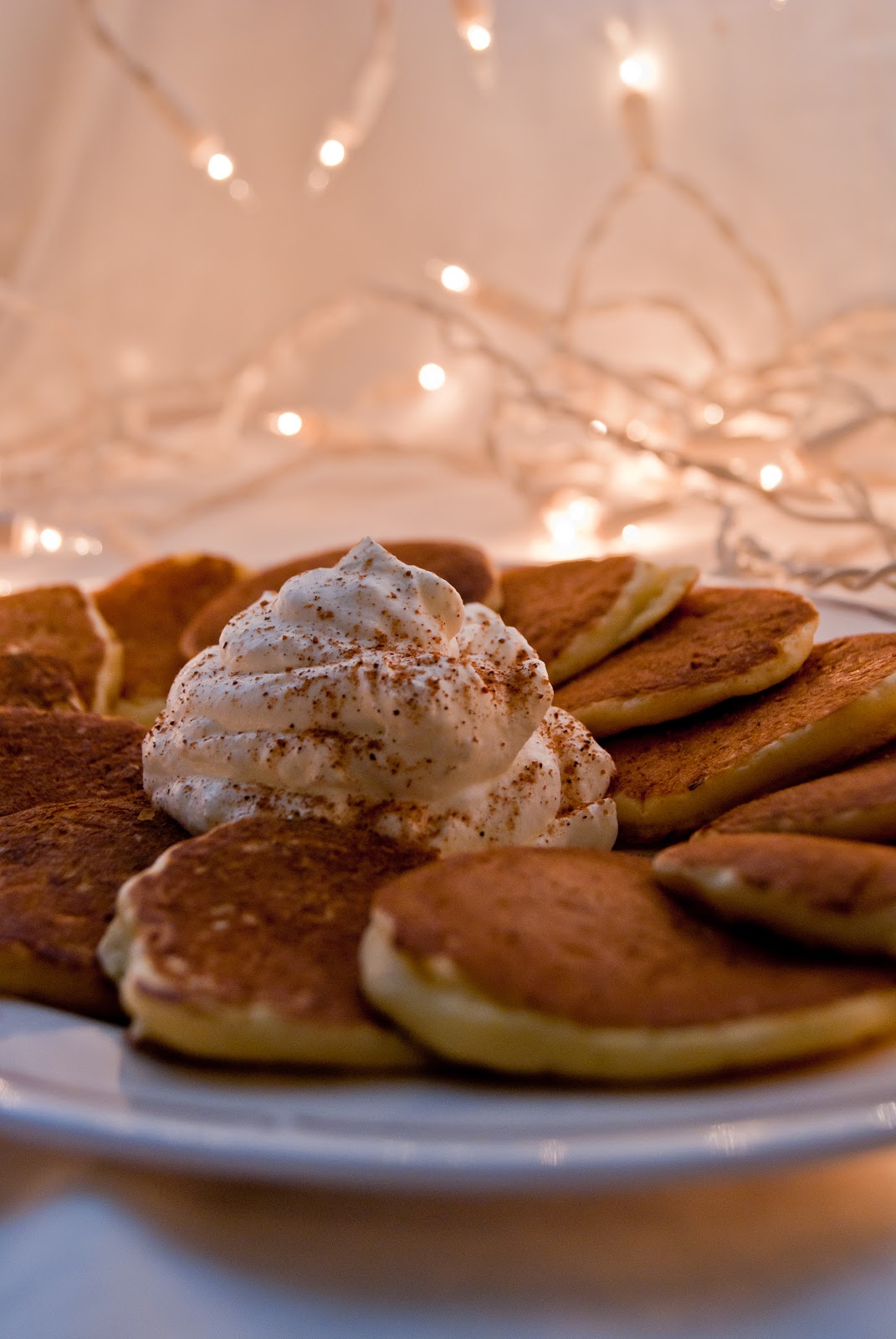
Serve six dollar-size pancakes per person and top each serving with whipped cream, sprinkling with nutmeg.


The Verdict:
Well first off, this makes SO MUCH PANCAKE BATTER. Seriously. Especially when you're making dollar-sized pancakes. If you are a few hungry people and are making regular-sized pancakes, this is an okay amount. Otherwise, please half it at the very least.
Taste-wise, these are okay. I definitely got a festive feeling eating them. The eggnog is definitely tasteable, but it's not super strong, so if you want to make these and really like eggnog, I would suggest maybed increased the eggnog to milk ratio, adding some to the whipped cream, or making an eggnog sauce to drizzle on top. The whipped cream and nutmeg did increase the eggnoggyness of the dish as well. And speaking of - the recipe didn't mention if the whipped cream should be sweetened or not, but I'm just saying, unsweetened whipped cream is kinda ew. Overall, not something I would make often, but I ate more than one of my own free will.

Modernized Recipe:
(Adapted from LIFE 23 Jan 1956)


2 tablespoons BUTTER or SHORTENING
1 cup MILK
1 cup EGGNOG
2 cups AUNT JEMIMA PANCAKE MIX
WHIPPED CREAM
NUTMEG

1. In a large mixing bowl, melt the butter. Whisk in the milk and eggnog. Add the pancake mix and whisk until well combined and lumps are gone.
2. Heat a fry pan or griddle to medium heat. Lightly grease. Drop one tablespoon of batter for each dollar-sized pancake. Fry until puffy and golden brown, flipping once when the edges begin to firm up.
3. Arrange the pancakes on a plate with whipped cream. Sprinkle the nutmeg over top.