Showing posts with label 1930s. Show all posts

[HFF] Pineapple Caramel Upside-Down Cake (1935)


[In case you're wondering, yes, I did skip challenge #5. I can't get roastable cuts of meat here and I couldn't find a suitable alternative. Sorry!]


For this HFF challenge, I decided to go retro with a pineapple upside-down cake.

Let's talk about pineapples.

Dole advertisement, 1952
I'm going to focus on Hawaiian pineapples, since this recipe comes from a Dole cookbook. No one really knows when exactly the first pineapples were introduced to Hawaii, however, they were first recorded in 1813. Outside of Hawaii, early on, and before canning, pineapple was a mark of well-to-do tables. With it's unusual appearance and the fact that it was not easily grown in the continental states, pineapple was an exotic luxury for those who could afford it. In fact, early colonials were so entranced by pineapple that it was featured in art, design, ice and jelly molds, and even architecture!


Canning of pineapple began in Baltimore in the mid-1860s, but this fruit was imported from the Caribbean, not Hawaii. Pineapple canning in Hawaii first began with the quickly defunct Kona Fruit Preserving Co. in 1882, and it was not until 1901 that James D. Dole founded Dole's Hawaiian Pineapple Company. Dole's company flourished, and as a result Dole's can credited as a major contribution to the rapid growth of the canned pineapple industry.

By the 1920s, canned pineapple was readily available and by 1930 Hawaii was leading the world in the production of canned pineapple. By 1933 there was also a rapid growth in sales of canned pineapple juice, an important by-product which increased industry profits after the Great Depression. However, by the end of World War II, the industry had changed. New competitors emerged and cheap foreign canneries eventually replaced all the canneries on Hawaii. Today, only fresh pineapples are grown in Hawaii, and mostly for local consumption. Nevertheless, Hawaii's pineapple legacy is so strong that even today dishes made with pineapple are often called "Hawaiian style".

*****

The Ladies' Home Journal, 1953
Upside-down cakes likely grew out of old American methods of cooking. "Skillet cakes" were traditionally cooked in a cast iron pan, on top of the stove. With fruit and a sugar put in the pan first, when inverted onto a plate the cake would appear already decorated. It's quite probable that the classic pineapple upside-down cake has it's origins in these recipes. 

In 1925, Dole ran a contest calling for canned pineapple recipes. In the end, one recipe for pineapple upside down cake was published in the compiled cookbook, however, Dole apparently received 2,500 recipes for the cake! Clearly by 1925 pineapple upside-down cake was widely known. Although pineapple upside-down cake enjoyed a lot of popularity, today it is often seen as "retro" and a nostalgic symbol of the mid-century, especially when topped with vibrant red maraschino cherries!


Today's recipe comes from a 1935 cookbook released as part of a Dole advertising scheme. 


HFF Challenge:
6. Juicy Fruits (March 11 - March 24) It’s fruits! Do something with fruits. It doesn’t get more simple than that. Bonus points for use of heritage crops and ingredients!


Original Recipe:


The Verdict:
Amusingly, when Mr. Man saw me buying canned pineapple, he became very alarmed and said to me, "You better not be making one of those cakes." He complained that upside-down cakes are always soggy and gross because of the fruit. Clearly this retro classic isn't a welcome throwback for all of us.

In the end, the cake itself was okay. It fell quite a bit after I took it out of the oven. The "caramel" topping was basically goop. And with 1/2 cup of sugar, it was VERY sweet. The pineapple was the best part, as it cut the sugary sweetness and added flavor, which was otherwise lacking.

Mr. Man and I both rated this cake "just okay". It's definitely edible and not awful, but the mushiness and over sweetness of the topping really didn't do this cake any favours.


Notes:
I can't get canned Dole fruits, so I used another brand. I did use Dole pineapple juice.
I didn't put 3 tablespoons of butter on the bottom, but I did liberally grease the pan.
I baked the cake in an oven-safe frying pan.


Sources:

A Supper Drink (c.1936) ★★★


Peppermints are not really a big thing here in Japan. Sure, you can buy little breath mints, but you can't get real peppermints here - or at least not in my rural area. Luckily I thought to bring some along from Canada, so I broke out my one and only package of Wilhelmina Pepermunts.

I am half Dutch, so peppermints are kind of special to me. My grandfather always kept peppermints near at hand - in his pocket, in the car, and in his greenhouse. I remember one time when I sneaked into the greenhouse just to raid the peppermint stash. His peppermints were usually the cheap bulk barn kind. On the other hand, Wilhelmina is a pretty famous brand, with over 120 years of history, so I figured they were an appropriate choice for this recipe.

Original Recipe:


The Verdict:

You know, I'm not actually a big fan of milk. I get a milk box every day with my school lunch, but I never drink it. However, I didn't mind this drink! I wouldn't pick it over, say, hot chocolate or apple cider, but I could definitely finish a cup of this. I did find that two peppermints didn't really affect the taste much, so this is definitely a recipe where you can adjust to suit your tastes. I gave the rest to Little Y and she enjoyed it a lot, too.


Modernized Recipe:

(Adapted from Delicious milk dishes and drinks)

1 cup milk, boiling
strong peppermints, to taste

1. Place the peppermints into the boiling milk and stir until dissolved.
2. Drink while hot.


St. Patrick's Day Party (c. 1931)

I love that The Settlement Cook Book includes holiday menus like this one for a Saint Patrick's Day party. Its rather rare to find menus like this in early cookbooks, especially for something other than Christmas. The theme here seems to be green + mint - not so different from a menu we might see today! There is also an emphasis on potatoes and shamrocks, two items which have continued to symbolize Irish heritage even today.


Recipes for Red Hots (1929-1972)

Still hanging on to those spicy cinnamon hearts from Valentine's? Also known as Red Hots (brand name) or cinnamon imperials (generic name), cinnamon hearts hold a fond place in my childhood memory. As a child I often accompanied my mother on long car trips, so there was nearly always some sort of candy or snack close at hand. Around Valentine's Day, cinnamon hearts made an appearance, and I can still recall the addictive, spicy sting of their flavour on my tongue. This year, Mr. Man brought some home for me, but oddly I found that I couldn't quite tolerate the flavour as much as I could when I was younger. I wondered if I could find some strange historical recipe so that I could use them up rather than waste them. Amazingly, recipes using cinnamon candies date back to at least 1929, which was before the Red Hots brand was trademarked. These candies are almost always paired with apple(sauce) and/or Jell-O, and often seems to hold a special place on holiday tables, as a symbol of family heritage and tradition.

So, compiled for your convenience, some recipes using cinnamon heart candies:

Applesauce with red hots 

From: Better Homes and Gardens Junior Cook Book (1963)
Source


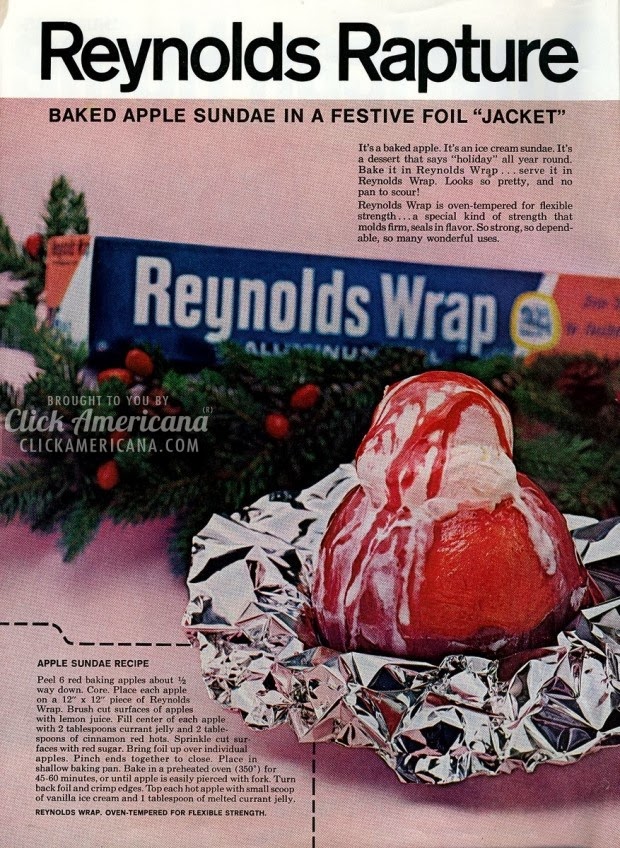
Apple Sundae

From: Reynolds Wrap advertisement (1972)
Source


Imperial Salad/Cinnamon Apple Salad

From: The Parker Cook Book (1932), updated by Laura Gutschke
Source

IMPERIAL SALAD
Cox's cinnamon apple salad called for an usual mix of ingredients that includes cottage cheese, walnuts and red cinnamon candies, famously known as Red Hots. (Another generic name for the candy is cinnamon imperials.) Surprisingly, they work well together.
The candy's intense cinnamon flavor reduces to a subtle hint when cooked in the sugar syrup in the following recipe.
The original instructions called for cooking cored apples whole in the red syrup and stuffing them with a mixture of cottage cheese and walnuts. I instead sliced the apples. I also eliminated the lettuce and mayonnaise that was included in the serving directions.
The apples also can be enjoyed without the cottage cheese.
CINNAMON APPLE SALAD
Ingredients
1/2 cup sugar1/2 cup water
1 cup red cinnamon candies
4 crisp apples, sliced
Cottage cheese
Chopped walnuts
Directions
1. In skillet, cook sugar, water and cinnamon candies over medium-high heat to make a syrup. Stir often to blend well.
2. Add apple slices to the syrup mixture and reduce heat to medium. Cook until apples are tender but not broken, about 10 to 15 minutes. Gently stir occasionally.
3. Remove cooked apples from syrup and place slices skin side down on serving platter. Chill in refrigerator about one hour.
4. In a separate bowl, mix about 2 tablespoons walnuts into 1/2 cup cottage cheese for each serving.
5. Place 5-6 apple slices on a plate and top with serving of cottage cheese mixture.


Applesauce Salad

From: Recipe collection, undated
Source


Cinnamon Candy Jell-O Salad

From: unknown (1961)
Source
1 pkg. Cherry Jello
1/4 C. cinnamon candies (Red Hots)
1 C. hot water
2 C. applesauce
Dissolve candies in hot water and add Jello. Stir into applesauce and chill.


Cinnamon Apple Salad Dessert

From: The Evening Independent (1929)
Source


Blushing Snowballs

From: Westinghouse recipe pamphlet (1950s)
Source


Alphabet Pie 

From: 250 Superb Pies and Pastries, Culinary Arts Institute (1941)
Source

Cinnamon Creme

From: Eugene Register-Guard (1959)
Source


Washington's Birthday Luncheon (c.1931)

Unless you're a new reader, you might already know that I'm Canadian. But I get a kick out of American holidays too! That's probably because I've spent a few years living there - in California for a year and later in Ohio for 4 years. So yes, Presidents' Day is today! Also called Washington's Birthday. If you want to get all festive and historical, try out this 1930s menu for a luncheon from The Settlement Cook Book! I've also done the work of finding the referenced recipes, so they're also included below the menu itself.

Original Recipe:


 So let's break down this menu.

Orange halves with maraschino cherries: Washington is often associated with cherries, and while some "cherry tree chopping" story has been debunked as myth, he did apparently like to eat the fruit.

Chicken a la Maryland: I'm not really sure where they're going with this one, as Washington is well-known to have been very fond of fish, not chicken.

Southern Sweet Potatoes: I'd guess this is a nod to Washington's southern heritage.

Virginia Corn Bread: There was no such recipe, but there were recipes for plain old "Cornbread." Since Washington was born in Virginia and lived there at Mt. Vernon, I assume this is a convenient re-naming.

Cherry Salad: Again, the association of Washington with cherries. I found it interesting that this recipe actually specifies in the instructions that it is good for celebrating his birthday.

Boston Brown Bread: Boston is a place that is really steeped in American heritage. During the American Revolution, Washington forced the British out of Boston, which saved the city from an ongoing siege.

Chocolate Roll: Again, this seems like an odd choice. Why not Washington Cake?!?! I mean, really...It's an obvious choice...

Nuts, Raisins, Coffee: GW apparently loved nuts, especially hazelnuts and shellbacks (similar to pecans).

If you're extra curious, there's lots more information on what Washington and other Presidents liked to eat here!

Portsmouth Orange Cake (1932) ★★★★


The cake I want to share with you today has a bit of an interesting history, much of which is strongly tied to New Hampshire. Portsmouth Orange Cake is included in a list of suggested foods to eat while in New Hampshire:

"Spongy and sweet in all the right places, Portsmouth orange cake is a favorite of many New Hampshire natives, who feasted on the dessert as children and who now consider the soft cake a summertime staple. It is usually made with orange zest or rinds and often with orange-flavored cream-cheese frosting. But some Portsmouth area restaurants and home bakers also add fresh-picked cranberries from New Hampshire bogs to sweeten the already wonderful after-dinner delight."

The earliest mention I found was in Green's Receipt Book (1894). This book, amazingly, seemed to have been very devoted to this particular cake recipe, as the title page actually advertises in very large print that it includes "the original receipts for Famous Portsmouth Orange Cake..." The first section of recipes is for cakes, and is preceded with a note stating, "First, I will give the receipts collected in Portsmouth, including Famous Portsmouth Orange cake, Black cake, and Walnut cake." Below is the supposed authentic recipe in its entirety:

It seems like the recipe was consistently popular, as forty years later it was still being printed in cookbooks. I've found several mentions of the cake from the 1930s, not including the version featured here, which is from 1932. It was also included as a suggestion for a worker's lunch in Ida Bailey Allen's Cooking, Menus, Service (1935) and a 1935 advertisement in the Portsmouth Times refers to a "Mello Gold Orange Cake" as "an ideal hot weather treat," which may or may not be the cake we're discussing here. I found newspaper references to Portsmouth Orange Cake throughout the 1970s and 80s as well. One of these mentioned the cake as part of a Christmastime feast. A recipe for the cake was also included in the 1975 The Thirteen Colonies Cookbook, a book highlighting foods from each of the original 13 colonies of the United States. This recipe is very basic and different from older recipes. If Portsmouth Orange Cake was a recipe brought over by settlers from the Old World, then this may be an early version of the recipe. Oranges had been introduced throughout Europe by the mid 1600s. It is interesting to note that the Thirteen Colonies version is most similar to the 1894 version from Green's (compare the methods of handling the eggs). This recipe is a good example of how methods and ingredients can change over time.

Original Recipe:


The Verdict:

Overall, not bad. But not amazing either. The cake itself was really dense and a bit bland. It also stuck to the pan a lot, but luckily because it was so dense I pried it out without any breakage. The icing was okay, but tasted way too strongly of orange zest. It overpowered every other part of the cake. As a whole, it was a nice concept - the fresh sections of orange in the middle were really nice and refreshing too. I would definitely eat this voluntarily, but I wasn't impressed enough with the cake to want to make this again myself. I'm going to give this 4 stars, but its probably closer to 3.5 stars.


Modernized Recipe:

(Adapted from The Sunny South and Golden West Cook Book)

3 EGGS
1 cup SUGAR
3 tablespoons ORANGE JUICE
1 cup FLOUR
1 teaspoon BAKING POWDER

1 ORANGE
2 cups ICING SUGAR
2 tablespoons LEMON JUICE
2 tablespoons WATER

1. Preheat the oven to 350F and liberally grease two 9 inch round cake pans.
2. In a mixing bowl, beat the eggs and sugar together until thick. Stir in the orange juice. Add the flour and baking powder and fold together.
3. Divide the batter between the two pans and bake for 10 - 15 minutes.
4. While the cakes are cooling, make the frosting. Mix the zest of half an orange with the icing sugar. Add the lemon juice and depending on the consistency, add water to make a thick but spreadable icing.
5. Spread the icing on the top of the first layer, and fill with thin sections of orange (thinly slice an orange, cut each slice in half, and cut off the peel). Place the second layer of cake on top and spread the rest of the icing on the top of the  cake layer.

Sources:

"Food Not To Miss In New Hampshire." KC Community News. N.p., n.d. Web. 02 Nov. 2013. <http://prewww.kccommunitynews.com/travelgetaways/18691300/detail.html>.

Green, Ralph. Green's Receipt Book. Concord, N.H.: Republican Associated, 1894. International Correspondence School & American School of Correspondence Directories Archive. Web. 2 Nov. 2013. <http://www.icsarchive.org/icsarchive-org/paperback/cookbooks/greens_receipt_book_1894.pdf>.

Mello Gold Orange Cake. Advertisement. Google News. N.p., n.d. Web. 2 Nov. 2013. <http://news.google.com/newspapers?id=vZFeAAAAIBAJ&sjid=t0sNAAAAIBAJ&dq=portsmouth%20orange%20cake&pg=2584%2C3133062>.

Olver, Lynne. "New Deal Food Programs." The Food Timeline. N.p., n.d. Web. 02 Nov. 2013. <http://www.foodtimeline.org/fooddecades.html>.

Maple Velvet (c. 1930) ★★★★★


Just a quick and simple recipe today! I couldn't find much history on it, except for two mentions of the recipe in newspapers. The first was in the Bolivar Breeze, October 9, 1947 (New York) and the second was printed in the Freeport Journal-Standard on November 13, 1947 (Illinois). The first suggests the recipe as a party drink for Halloween. In that case, it seems I'm three days too late, whoops!
Its possible this recipe may have been making the newspaper rounds in the mid 1940s. I'm not sure when this Canada Dry pamphlet I found the recipe in was printed, but we can definitively conclude that it wasn't any later than 1947!

Original Recipe:


Maple Velvet
Service for 1
In a tall glass place two tablespoons of pure maple syrup. Add a generous helping of vanilla ice cream. Fill the glass with ice cold Canada Dry and stir until well mixed.


The Verdict:

I don't really know what else to say except that this was freaking amazingly delicious! I've always been so-so about ice cream floats, but I'm in love with this. I felt like none of the flavours were overpowering and instead they all worked together really well. The addition of maple syrup was genius, and I think this wouldn't be as good if it was just ginger ale and ice cream. I hadn't ever heard of this recipe before, but I wish I had. I think this really could have been a great candidate for a Canadian classic, given the use of maple syrup and Canada Dry. 

Modernized Recipe:


2 tablespoons PURE MAPLE SYRUP
1 large scoop VANILLA ICE CREAM
GINGER ALE to fill the glass

1. Pour the maple syrup into a tall glass. Add the ice cream and fill with ginger ale. Stir to mix well. Drink and enjoy!

Vanilla Ice Cream with Marshmallows (c. 1931) ★★★★★


Today I have a menu for "Christmas Dinner," taken from The Settlement Cookbook. This cookbook was originally published in 1901 and was so successful that a further 34 editions were published. Today's excerpt comes from the edition published around 1931, which seems to be one of the more popular editions. In this edition the author, Lizzie Black Kander, includes several menu suggestions, including ones for holidays such as Christmas, St. Patrick's Day, Valentine's Day, Lent, and Washington's Birthday. Since making the whole Christmas menu would be a little...overwhelming, I chose to make just one dish, marshmallow ice cream. The menu didn't indicate a specific flavour, but the book gives a few varieties, including chocolate, coffee, orange, and New York.
What caught my attention while reading this cookbook was that it was written by a Jewish woman who wanted to assimilate young Jewish girls into mainstream American society. One might see Kander's fight for Americanization of immigrants as a negative thing - after all, she was encouraging the abandonment of traditional culinary values. However, it would be difficult not to describe Kander as a strong, courageous woman who actively sought out her goals (despite the fact that she proclaimed the importance of the woman in the domestic sphere).
The focus of the cookbook explains the emphasis on American holidays in the menus section. However, I did notice a few traditional Jewish recipes throughout the book, such as matzo balls, matzo pudding, and kugel. There are also a number of German and Eastern European influences present - in fact, the book is one of the largest collections of Jewish and German recipes published in the United States.
The Settlement Cookbook was also a charity cookbook - its aim was to raise funds for the Jewish Settlement House in Milwaukee, Wisconsin ("settlement work" was a term used to describe charitable work among immigrants). The success of the book meant that charities in Milwaukee benefited from the book's sales for over 75 years.
Overall, Kander's work was extremely influential in Milwaukee and the United States as a piece of socio-cultural history. Indeed, it is still influencing North American society today, in facsimile and new revised editions.

Original Recipe:


The Verdict:
This ice cream is ridiculously creamy. I was shocked at how silky it was on my tongue. I liked the flavour, but I think I might have preferred the chocolate variety a little more. Mr. Man thought it was cream cheese at first. He didn't like it, but that's because he doesn't like marshmallows.
I also happened to accidentally burn a little bit of the mixture while it was on the stove, but it actually gave a nice toasted marshmallow flavour. Really, this recipe is nice the way it is, but next time I would toast the marshmallows beforehand.

Modernized Recipe:
(Adapted from The Way to A Man's Heart ... The Settlement Cook Book)

1 cup MILK
20 MARSHMALLOWS
1 cup CREAM or EVAPORATED MILK
1 teaspoon VANILLA

1. In a medium saucepan, heat the milk. Cut the marshmallows into small pieces and add to the hot milk, stirring until dissolved.
2. To the saucepan, add the vanilla. Let cool.
3. Whip the cream until stiff peaks form. Gently fold into the cooled marshmallow mixture.
4. Put the ice cream mixture into the freezer to set or follow the directions on your ice cream maker.

-----
Sources

Fritz, Angela. "Lizzie Black Kander and Culinary Reform in Milwaukee, 1880 - 1920."Wisconsin Magazine of History 87.3 (2004): 36-49. Wisconsin Historical Society. 2007. Web. 20 Dec. 2012. <http://content.wisconsinhistory.org/cdm/compoundobject/collection/wmh/id/42933/show/42910>.

"Lizzie Black Kander." Wikipedia. Wikimedia Foundation, 12 May 2012. Web. 20 Dec. 2012. <http://en.wikipedia.org/wiki/Lizzie_Black_Kander>.

"The Settlement Cook Book." Feeding America. Web. 20 Dec. 2012. <http://digital.lib.msu.edu/projects/cookbooks/html/books/book_52.cfm>.


Cocoanut Dainties (1931) ★★★★


I found this recipe at The Old Foodie. I liked it because it looked super simple and I also thought it would be a good treat for Little Y, who loves coconut. They're also pretty cheap to make, with only 3 ingredients.

Original Recipe:
Cocoanut Dainties.

Here is some cooking which a small child could do. The ingredients needed are:-

Four table-spoonfuls of sugar, 8 tablespoonfuls of desiccated cocoanut, and the whites of two eggs. Beat the whites of the eggs to a froth, add the sugar, and beat well again. Then stir in in the cocoanut.

Drop teaspoonfuls of this mixture on to a greased slide, and bake about 10 or 15 minutes in a moderate oven.

(A Parrot Card is awarded to Jean Douglas, Coast Road, Mirboo [?] North, Gippsland.)


The Verdict:
Not bad. I'm not a huge fan of coconut either, but I don't mind these. They did turn out pretty chewy, and I was hoping for more of a crunchy meringue, but still good (I realized as I was writing this up that I accidentally used half the amount of sugar. I didn't even notice, however, I wonder if that had anything to do with the texture.)! Perhaps they could benefit from a splash of vanilla, but otherwise they're fine as is. They're a great option for when you'd like a sweet treat but are lazy. It took minutes to whip these up and the great thing is that they don't spread, so you could probably even fit all of them on one baking sheet. They are best eaten the day of, because otherwise they tend to get sticky, even in this dry winter air.
Yield: 16 dainties


Modernized Recipe:
(Adapted from the Children's pages of The Argus, December 12, 1931, found at The Old Foodie)

2 EGG WHITES
4 tablespoons SUGAR
8 tablespoons DESICCATED COCONUT
1 teaspoon VANILLA EXTRACT (optional)

1. Preheat oven to 350F. Line a cookie sheet with parchment paper.
2. In a large bowl, beat the egg whites until frothy. Add the sugar and beat until stiff peaks form. Gently fold in the coconut.
3. Drop teaspoonfuls of the mixture on the prepared cookie sheet. Bake about 10 or 15 minutes until the tips become golden brown. Let cool and store in a well-sealed container.


Sint Nickolaas Koekjes (Speculaas) (1937) ★★★★★

Ginger Bread by Anton Pieck (1895 - 1987)
My maternal grandparents emigrated to North America after WWII. As a result, I have a long-time love of Speculaas - and not just at Christmastime! And imagine my surprise when the flavour of this traditional cookie went mainstream over the past year, with the cult following of speculoos spread/biscoff cookie butter.

Speculaas are something like a Dutch answer to gingerbread (which was super popular in the British Isles). Like gingerbread, speculaas can be made different ways: thin and hard, thick and bready, or filled with almond paste. While the terms speculaas and speculoos are often considered fairly interchangeable, there is a difference. Add in "biscoff" and the whole thing just gets downright confusing. Speculaas is a Dutch word for the cookie, which is usually of the thicker, bready type, more like (non-crispy) gingerbread. Speculoos is the Belgian word and tends to be a thin, hard cookie with less spice. Biscoff (biscuit + coffee) is the name that speculoos are sold under in North America. Therefore speculoos = biscoff, which do not = speculaas.

Although the texture may be different, the flavour of speculaas appears in many lowland European countries, especially in holiday sweets. The etymology of the word "speculaas" is not definite, but the two most popular theories are that it is derived from the word "speculum" or "specie". Speculum ("mirror") would refer to the mirror image of the stamps or molds, while specie would connote a "spiced" cake. Two other options are the  Latin word "speculator" to refer to St. Nicholas (Sint Nickolaas), "he who sees everything", or "specerij", which again, means "spice". In Germany they are known as spekulatius. There is also a local variety from Hasselt, Belgium, called speculation, which was licensed in 1870.

The cookie itself dates back to at least the Middle Ages, when cinnamon, nutmeg, and cloves were commonly used and foods such as gingerbread were popular. They were certainly being baked by the 15th century, when couples in love would express their desires through the gift giving of speculaas, shaped as humans or even in a representation of St. Nicholas himself. While originally based in religious iconography, nowadays speculaas come in a variety of shapes, including elephants, horses, ships, farmhouses, windmills, chickens, trees, birds, etc. Prior to around 1850, speculaas were made from rye flour and honey, resulting in a very hard cookie which could only be eaten when softened.

In the Netherlands, the feast of St. Nickolaas (Sinterklaas) is celebrated on December 5th, so hence the date for this post. 

I found this specific recipe on a website for a Dutch historical village in Pella, Iowa, which was founded in the 19th century by Dutch immigrants. The recipe comes from a 1937 community cookbook which was full of ethnic recipes (as community cookbooks often are). Perhaps this is why the recipe specifies that these are "Sint Nickolaas Koekjes". Any Dutch person would certainly know the tradition of "speculaas", so the recipe title must indicate that the recipe and hence the cookbook were for a broader audience. As a disclaimer, I do not know if any revisions were made by the website, so the recipe may not have been originally written in this form. However, given the sparse instructions, I don't think many - if any - changes have been made.


Original Recipe:
Dutch Santa Claus Cookies
Sint Nickolaas Koekjes (Speculaas)

10 oz. butter
1 egg
10 oz. brown and white sugar mixed
2 t. cinnamon
1 t. nutmeg
1/2 t. cloves
1 lb. flour
1 t. soda dissolved in 2 T. sour milk

Mix—form into ball—chill.
Slice thin and bake.

The Verdict:
I was curious to see how this would work out, because normally speculaas (at least today) contain far more spices, including ginger, star anise, coriander, and white pepper. There are also no directions for mixing, so I followed the usual standard for making cookies. However, I have seen some recipes which follow the steps for making pastry: cut the butter into the flour and then adding the other ingredients.
The cookies were delicious, although a tiny bit bland spice-wise. If you like a real punch of spice, this is not the cookie. Or it could be, just add more spices. Ginger would really help, I think. Nevertheless, they are yummy as is! I would certainly make and eat these again happily. Mr. Man enjoyed them as well. They are soft and delicious right out of the oven, but harden up just a bit once cooled. They're also not super sweet, which is nice because it means you can eat five and still feel okay. Not that I tried...
Yield was 30 cookies, slightly smaller than my palm.

Modernized Recipe:
(Adapted from Genuine Holland Recipes, found at Pella Tulip Time)

10 ounces UNSALTED BUTTER
5 ounces BROWN SUGAR
5 ounces WHITE SUGAR
1 EGG
2 teaspoons CINNAMON
1 teaspoon NUTMEG
1/2 teaspoon CLOVES
1 teaspoon BAKING SODA
2 tablespoons BUTTERMILK
1 pound FLOUR

1. In a large bowl, beat together the butter and sugar. Mix in the egg. Add the spices.
2. Dissolve the baking soda in the buttermilk (or use regular milk with some lemon juice to make it sour) and stir into the dough. Blend in the flour and knead until well-combined. You may need extra flour. It should not stick to your hands.
3. Form the dough into a ball or a log and refrigerate overnight. I would suggest the log, otherwise you're going to have to wait for an hour for the dough to come to room temperature to roll by hand.
4. To bake the cookies, preheat oven to 350F. Slice into small rounds or roll into balls (or use a speculaas mold if you happen to have one). Bake on a cookie sheet for about 14 minutes.

-----
Sources

Muusers, Christianne. "Speculaas with Rich Almond Stuffing." Coquinaria. 29 Oct. 2004. Web. 03 Dec. 2012. <http://www.coquinaria.nl/english/recipes/speculaas.htm>.


"SPECULAAS FROM HASSELT." Grandma's Design | Recipes. European Commission. Web. 03 Dec. 2012. <http://www.grandmasdesign.com/media.php?recipes=NTAwMjA=>.

"Speculoos." Wikipedia. Wikimedia Foundation, 28 Nov. 2012. Web. 03 Dec. 2012. <http://en.wikipedia.org/wiki/Speculoos>.

"Vermeiren Speculoos." Vermeiren Speculoos. 2012. Web. 03 Dec. 2012. <http://www.vermeirenprinceps.be/index.php?prodid=>.

Noodle Ring with Cheese Sauce (1939) ★★★★

I've been wanting to do some new posts for a while now, but I had a super busy couple of weeks with school. I managed to find a bit of extra time this weekend, so I whipped up this interesting recipe from 1939. Making it, I thought it might turn out really gross, but I was actually pleasantly surprised.


Original Recipe:

The Verdict:
Mr. Man and I settled on a high four stars for this noodle ring. We both thought it was delicious, even though it was a little mushy. It was kind of like a cross between mac n cheese and a cheese souffle. I put green peas in the center of the ring, much to the dismay of Mr. Man, who said he would have given it five stars otherwise. I think he's crazy.
It's definitely an edible recipe, and fairly simple to make as well. I doubled everything because I was using my bundt pan. Even then it didn't fill the whole thing up, so obviously the recipe is meant for a much smaller mold.

Modernized Recipe:
(Adapted from New York World's Fair Cook Book: The American Kitchen)

The original recipe is easy to follow. Add pepper if desired.
Make sure to use a whisk to prevent lumps in the sauce, and whisk in the eggs quickly, one by one, to prevent cooked lumps of egg from forming.


Pacific Red Pineapple Sauce (1939) ★★★★★

This recipe for a sweet sauce comes from the portion of the cookbook dedicated to the Southwest and the West. The section doesn't really make distinctions between the states, but considering the recipe calls specifically for Oregon strawberries, I think it's fair to make a guess that this is a recipe from Oregon.
I love the name of this recipe - something about the phrase "pacific red" makes me think of a vibrant sunset over the Pacific ocean.


Original Recipe:


The Verdict:
Full disclosure - I did use frozen strawberries. It's just more economical, I mean, I already had them in my kitchen. I also only had 3/4 cup of pineapple juice, so I added some crushed pineapple to reach the full 1 cup amount. I love how simple this recipe is, though - three ingredients, 1 cup of each. I was pretty sure this would turn out super yummy, and I was right! This sauce is really lovely. My only complaint was that it was a tad sweet. Next time I would add a bit of lemon juice to cut the sweetness a bit. I also had to boil mine a little harder, just because the frozen berries released a lot of liquid. It will thicken a little bit when it cools. I half-mashed my berries, because I like to have chunks. Actually, the crushed pineapple I added made some nice crunchy bits too. I love having that texture, but Mr. Man shuddered when he looked at it, so I guess if you don't share my enthusiasm for lumpy sauce, it can be pureed. I would definitely make this again - in fact, I might keep this as my go-to strawberry sauce.


Modernized Recipe:
(Adapted from New York World's Fair Cook Book: The American Kitchen)

The original recipe is easy to follow.


Rancho Spiced Beef (1939) ★★★★

I found this neat cookbook from 1939, called New York World's Fair Cook Book: The American Kitchen. The cookbook features all sorts of interesting recipes from across the United States, organized by state/region. It's a really cool read to see the regional specialties. This recipe is from the southwest/west section, which includes the states of Missouri, Oklahoma, Texas, Nevada, Wyoming, Utah, Colorado, and Montana.  Unfortunately this makes it impossible to know exactly which state it is from.


Original Recipe:


The Verdict:
It was pretty good. I was so scared of the amount of cayenne and cloves, but surprisingly they weren't overpowering. It was spicy, but not so much that wimpy me couldn't eat it. Actually, it was probably better than eating tacos (Yes, eating tacos is an ordeal for me. For some reason I just cannot handle spicy!). The cloves weren't overpowering either, which was nice. There was a nice crust on the outside from the spices, but the inside of the roast was pretty blah. This could be because I didn't marinate it overnight, though. If you're like me and forget to do things ahead of time, just chop your roast up a bit so that there's more surface area to get a crust. The only other alteration I made was to add the wine with the water, just because Little Y was eating it too and I wanted the alcohol to be a little weaker. Oh, and the 1 tablespoon of flour apparently didn't thicken the sauce (Mr. Man did it for me), so it may require extra. Overall, a nice and somewhat different flavour


Modernized Recipe:
(Adapted from New York World's Fair Cook Book: The American Kitchen)

2 1/2 pounds BEEF SHOULDER
1/2 teaspoon GROUND CLOVES
1/2 teaspoon ALLSPICE
1/2 teaspoon CAYENNE
SALT, to taste
PEPPER, to taste
1 clove GARLIC
1 tablespoon BUTTER, melted
1 cup SHERRY or WHITE WINE
1 cup WATER
2 BAY LEAVES
1 teaspoon LEMON JUICE
1 tablespoon FLOUR

1. In a small bowl, mix the cloves, allspice, cayenne, salt, pepper, and garlic. Rub it all over the beef.
2. In the same bowl (emptied), mix together the lemon juice and the butter. Pour it over the beef. Let it marinate overnight.
3. In a crockpot, add the water and bay leaves. Add the marinated beef. Cook on high for 3-4 hours and add the wine. Cook for another 1-2 hours, or until the meat is tender and easy to shred. Add 1 tablespoon of flour to thicken the sauce.