Showing posts with label candy. Show all posts

[HFF] Valentine Crunch (1961)


It's time for Historical Food Fortnightly challenge number four! No surprise to anyone, I'm sure, this challenge's theme is based on Valentine's Day and it's sweet traditions.

Now, HFF technically describes "historical" to mean anything up to 1960, so I'm fudging it a little here with this 1961 recipe. It comes from the Lakeland Ledger, a newspaper based in Florida. 
The Challenge:
4. Sweets for the Sweet (February 12 - February 25) It’s sugar, and maybe spice, and definitely everything nice. Test out a historic recipe for sweets, sweetmeats and candies - but don’t let them spoil your appetite!

The Recipe:
Valentine Crunch
Yield: 1 pound


3/4 cup margarine
1 cup sugar
2 tablespoons water
1 tablespoon light corn syrup
1 cup chopped nuts
1/2 cup coconut, optional
1/2 teaspoon rum extract
1 cup semi-sweet chocolate pieces

Melt margarine in a heavy saucepan. Add sugar and combine well. Cook over low heat, stirring constantly, until mixture is well blended and begins to bubble. Add water and corn syrup and mix well. Continue cooking mixture over low heat, stirring frequently, until 290 degrees F. registers on a candy thermometer or until a drop in cold water "cracks" or is brittle. Remove from heat.

Stir in nuts, coconut, and rum extract. Pour out onto a cooky sheet. Cool to room temperature. Melt semi-sweet chocolate pieces over boiling water. Spread evenly over candy and set aside until firm. When firm, break into pieces
The Verdict:
Unfortunately, it seems that I've already got my recipe for challenge 24, "Redo". I'm not sure if it was the temperature or the corn syrup substitution, but my candy went from liquid and glossy to thick and crumbly. There was no "crunch" at all. I hoped it would keep together well once it cooled down, but unfortunately it didn't work out that way. Also, I found it way too sweet for my tastes - I think maybe having the chocolate mixed in instead of just on top might help...on the other hand, Mr. Man really loved it!

Notes:

* I can't get corn syrup here, so I tried using mizuame.
* I didn't have a thermometer, so I used the cold water method.
* I used almonds and peanuts as my nuts.
* I forgot the rum extract, so I sprinkled some on top at the last minute. I couldn't really taste it.


Ginger Tablet (1845) ★★★★


Ages ago, in my 4th out of 5 years in university, I submitted an essay to be published in an online undergraduate journal. Unfortunately my essay wasn't chosen, but they told me I was the first alternate choice and they encouraged me to apply again the next year. So my 5th year rolled around and I received an email from the editor, asking if I would apply this time as well. I brushed up my work a bit and resubmitted. And they accepted it! I had to go through gruelling edits, which took months to complete - all during a move to Japan!

My essay was finally published this November. If you're interested in Scottish-Canadian foodways, please have a look! The official title is Cookbooks as Sources of Scottish-Canadian Identity, 1845 – 1934. Its all about the first two Scottish cookbooks published in Canada and how they interact with and reflect Scottish and Canadian identities at the time. Its my first published work, and to be honest, I can see that it needs still more refining. But for an undergraduate work, I'm pretty pleased.

So without further ado, here is a recipe from one of the cookbooks I analyzed in my essay. Modern Practical Cookery was an early cookbook publication in Canada, but it had already been published in Scotland nearly 40 years earlier. It was the first Scottish cookbook published in Canada. Of course I wanted to pick a recipe from this book which was distinctly Scottish.

Before I started research for my essay, I had never heard of tablet (also called butter tablet or Swiss milk tablet). Its actually a traditional Scottish sweet, similar to sucre a la creme, something I ate when I was a child in Canada. The Oxford Companion to Food includes an entry on tablet:


"...a Scottish sweet made from sugar and milk or cream boiled to the soft ball stage (116C/240F), and then stirred vigorously to make it ‘grain’ or crystallize. It is poured into trays and allowed to set before being cut into smaller pieces or ‘tablets’. The texture of this confection resembles crisp fudge. It was known in the early 18th century when purchases of ‘tablet for the bairns’ were recorded in The Household Book of Lady Grisell Baillie (1692-1733), and Mrs. McLintock (1736) gave recipes for orange, rose, cinnamon, and ginger tablets in the earliest work on cookery published in Scotland."

I tried to find this reference in Lady Grisell's book, but all I could find was an offhand reference by the editor of a 1911 edition, edited by Robert Scott-Moncrieff: "Fruits and confections are frequently bought, and occasionally 'taiblet for the bairens.'" Scott-Moncrieff's version is highly edited and transcribed, so plenty is left out. I couldn't find any record of "taiblet" in the book. I suppose we'll have to take his word for it, as I am unable to get my hands on the original source.

Unfortunately, Mrs. McLintock's Receipts for Cookery and Pastry Work seems to be a rare book, so I was unable to examine it myself. However, Food Timeline includes an interesting blurb from Sugar-Plums and Sherbet: The Prehistory of Sweets by Laura Mason:

"Recipes for tablets flavoured with orange, rose, cinnamon and ginger were published in Glasgow by Mrs. McLintock in 1736. These are simple candy recipes, made only with sugar, water and flavourings. This is her recipe: "Orange Tablets with the Grate: Grate the Oranges, take 2 lib. of sugar, and a mutchkin of water, then clarify it with the White of 2 Eggs, and set it on a slow Fire, and boil it till it be almost candyed, then put in the Grate of the Oranges, and take your white paper, rub it with fresh Butter, pour it on your Paper, and cut in little pieces." This is a candy similar to those from the previous century. The word tablet has medicinal overtones, as in the commonly accepted meaning of a small flat disc containing some drug or health-giving substance...In tablet now made in Scotland, both orange and ginger are still found amongst the flavourings, but milk has become essential to the definition."

As for the name, the Oxford English Dictionary suggests that it may have come from medicinal origins, which isn't uncommon for candy. This seems especially possible considering the common flavours of ginger, cinnamon, rose, and peppermint.

So what do we know about tablet? It dates back to at least the 1730s. The candy likely had medicinal origins. Popular flavours included ginger, cinnamon, peppermint, rose, and citrus. The earliest recipes were mostly sugar and water, and the dairy component came later. The texture should be hard and grainy, rather than smooth and soft like fudge.


Original Recipe:


GINGER TABLET.

Clarify the sugar, as directed for barley sugar
(p. 308,) and boil it down, but not so high as for
barley sugar ; to know when it is candy high, dip
the end of a spoon in cold water, then in the boil-
ing sugar, and when it hangs to the spoon, ropy,
take it off the fire ; to two pounds of sugar, have
half an ounce of the whitest ginger you can get,
pounded and sifted, put it in the sugar and stir 
it, rubbing it well, and breaking all the knots 
with the back of the spoon against the side of the
pan ; when done, have the marble slab rubbed
over with butter, pour it on it, and let it stand
till quite cold, then score it into dice for orna-
ment, but not too deep, cut it into square cakes,
and lay it by in boxes.

TO MAKE BARLEY SUGAR.

Take two pounds of lump sugar, break it in
small pieces, take a clean brass pan, put in a pint
(mutchkin) of water, drop in the white of an egg,
and whisk it well, put in the sugar, put it on the
fire, and, when melted, bring it to the boil ; as
soon as it boils, draw it to one side, to make it
boil on one side of the pan ; skim it till it be
perfectly clarified, then set on the fire, and boil
it down quick ; in the mean time have a marble
slab ready, rub it over with a piece of butter ; to
know when the sugar is at a proper height, dip
the end of a spoon in cold water, then into the 
boiling sugar, and quickly into the cold water,
if the sugar has gathered round the spoon, slip it
off, and if it be hard, and crimps in your teeth, it
is enough ; take it off, and drop six or eight drops
of the essence of lemon into it, pour it on the
marble slab, and before it gets too cold, with a
pair of large scissors, cut it into long sticks, rol
them on the slab, and lay them to cool ; this do
as quickly as possible, as it will get too cold for
cutting ; when done, keep it in a box, or in some
place from the air, and it will keep a long time.


The Verdict:

Well, the Oxford English Dictionary may be on to something when it says tablet may have had medicinal origins, because this is like medicinal strength ginger. Wow! It's very strong - but delicious! I like it, but I can only eat a small bite at a time. Mr. Man loves ginger and he really loves this. It is very sweet as well, though.

One thing - I wish I had made the tablet a bit thinner, because it was quite the feat to cut through it. Its a very hard candy, although it dissolves in the mouth. It has a rough and grainy texture, very unlike the smoothness of fudge.

It takes a bit of time to make with all that boiling, but overall, simple and tasty. I may make this again with Little Y, as it strikes me as something simple enough that a kid could do a lot of the recipe.

As for clarifying the sugar with the egg white...its probably an optional step by now. I did it just for fun, but I'm not sure it accomplished much.

Note: I used unrefined brown cane sugar (or at least I think so...it looked like it anyway) to make this recipe. I think any kind works fine, since its measured by weight and boiled down. The most authentic way would be to use lump sugar  - I suppose if you have access you can buy it, or if you're really dedicated you could make your own, but its really just sugar wetted with water and formed to a cone.


Modernized Recipe:

(Adapted from Modern Practical Cookery)

1 pint water
1 egg white (optional)
2 pounds sugar
1/2 ounce ginger, powdered
butter for greasing

1. In a large pot, whisk together the water and egg white (if using). Add the sugar.
2. Cook over medium heat until the sugar is dissolved. Then bring it to a boil.
3. If you are clarifying with the egg white, as soon as it starts to boil, move the pot so that only half of it is on the burner. This will allow any scum to shift to the opposite side. Skim it off until there is nothing left to skim.
4. Simmer the candy until it reaches the correct temperature. Make sure to stir and scrape down the sides from time to time. It is ready when it reaches around 240-245F. You can test by dropping a bit onto a plate and seeing that it does not run, or when it reaches the consistency of soft putty when dropped in cold water.
5. When the candy is ready, add the ginger and mix well. Pour it onto a greased marble slab or into a greased pan. Smooth it with a spoon or spatula to the desired thickness.
6. Let the tablet cool completely. Score into dice for decoration and cut into squares.


Sources:

Baillie, Grizel, and Robert Scott-Moncrieff. The Household Book of Lady Grisell Baillie, 1692-1733. Edinburgh: Printed at the UP by T. and A. Constable for the Scottish History Society, 1911.

Davidson, Alan. The Oxford Companion to Food. Oxford: Oxford UP, 2014.

Mason, Laura. Sugar-Plums and Sherbet: The Prehistory of Sweets. Devon: Prospect, 1998.

Olver, Lynne. "The Food Timeline: Tablet." The Food Timeline. Accessed 31 Jan. 2015. <http://www.foodtimeline.org/foodcandy.html#tablet>.

"Tablet (confectionery)." Wikipedia. Wikimedia Foundation. Accessed 31 Jan. 2015. <http://en.wikipedia.org/wiki/Tablet_(confectionery)>.

Recipes for Red Hots (1929-1972)

Still hanging on to those spicy cinnamon hearts from Valentine's? Also known as Red Hots (brand name) or cinnamon imperials (generic name), cinnamon hearts hold a fond place in my childhood memory. As a child I often accompanied my mother on long car trips, so there was nearly always some sort of candy or snack close at hand. Around Valentine's Day, cinnamon hearts made an appearance, and I can still recall the addictive, spicy sting of their flavour on my tongue. This year, Mr. Man brought some home for me, but oddly I found that I couldn't quite tolerate the flavour as much as I could when I was younger. I wondered if I could find some strange historical recipe so that I could use them up rather than waste them. Amazingly, recipes using cinnamon candies date back to at least 1929, which was before the Red Hots brand was trademarked. These candies are almost always paired with apple(sauce) and/or Jell-O, and often seems to hold a special place on holiday tables, as a symbol of family heritage and tradition.

So, compiled for your convenience, some recipes using cinnamon heart candies:

Applesauce with red hots 

From: Better Homes and Gardens Junior Cook Book (1963)
Source


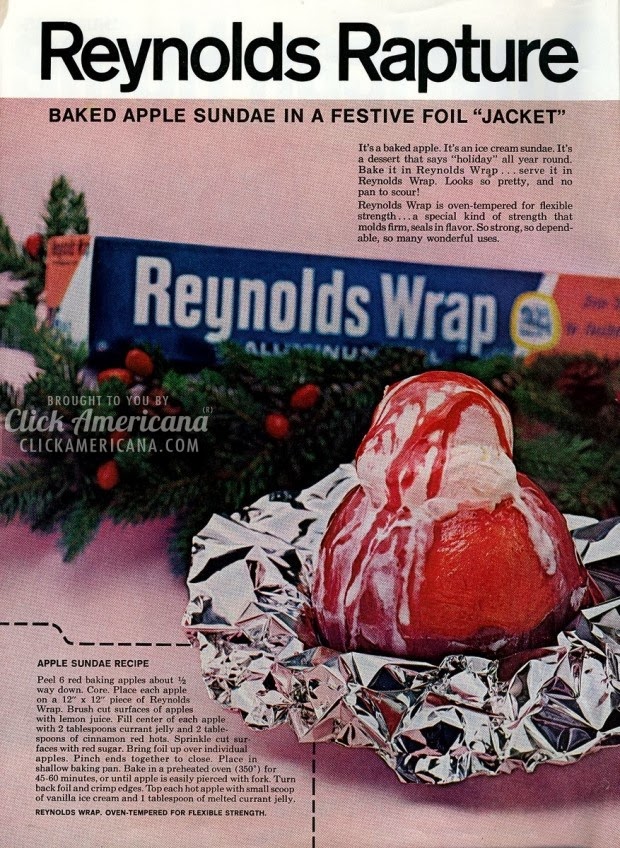
Apple Sundae

From: Reynolds Wrap advertisement (1972)
Source


Imperial Salad/Cinnamon Apple Salad

From: The Parker Cook Book (1932), updated by Laura Gutschke
Source

IMPERIAL SALAD
Cox's cinnamon apple salad called for an usual mix of ingredients that includes cottage cheese, walnuts and red cinnamon candies, famously known as Red Hots. (Another generic name for the candy is cinnamon imperials.) Surprisingly, they work well together.
The candy's intense cinnamon flavor reduces to a subtle hint when cooked in the sugar syrup in the following recipe.
The original instructions called for cooking cored apples whole in the red syrup and stuffing them with a mixture of cottage cheese and walnuts. I instead sliced the apples. I also eliminated the lettuce and mayonnaise that was included in the serving directions.
The apples also can be enjoyed without the cottage cheese.
CINNAMON APPLE SALAD
Ingredients
1/2 cup sugar1/2 cup water
1 cup red cinnamon candies
4 crisp apples, sliced
Cottage cheese
Chopped walnuts
Directions
1. In skillet, cook sugar, water and cinnamon candies over medium-high heat to make a syrup. Stir often to blend well.
2. Add apple slices to the syrup mixture and reduce heat to medium. Cook until apples are tender but not broken, about 10 to 15 minutes. Gently stir occasionally.
3. Remove cooked apples from syrup and place slices skin side down on serving platter. Chill in refrigerator about one hour.
4. In a separate bowl, mix about 2 tablespoons walnuts into 1/2 cup cottage cheese for each serving.
5. Place 5-6 apple slices on a plate and top with serving of cottage cheese mixture.


Applesauce Salad

From: Recipe collection, undated
Source


Cinnamon Candy Jell-O Salad

From: unknown (1961)
Source
1 pkg. Cherry Jello
1/4 C. cinnamon candies (Red Hots)
1 C. hot water
2 C. applesauce
Dissolve candies in hot water and add Jello. Stir into applesauce and chill.


Cinnamon Apple Salad Dessert

From: The Evening Independent (1929)
Source


Blushing Snowballs

From: Westinghouse recipe pamphlet (1950s)
Source


Alphabet Pie 

From: 250 Superb Pies and Pastries, Culinary Arts Institute (1941)
Source

Cinnamon Creme

From: Eugene Register-Guard (1959)
Source


Betty's Orange Candy (1905) ★★★


Another orange recipe! For some reason I am really loving orange right now. This recipe is so simple - only 2 ingredients!

Original Recipe:

Betty's Orange Candy Betty was Margaret's particular friend, so this was her favorite rule: 2 cups sugar. Juice of one orange. Boil till it hardens in water, and then pull it.

The Verdict:

It's okay. It mostly just tastes like sugar - the orange flavour is very subtle. Mr. Man and I decided on 3 stars, because it was edible but not that great overall. This recipe does get points for simplicity, though, although I recommend an extra pair of hands for the pulling.


Modernized Recipe:

(Adapted from A Little Cook Book for a Little Girl)

2 cups SUGAR
Juice of 1 ORANGE
Optional: additional orange extract or flavouring

1. In a medium pot, mix the sugar and orange juice on medium heat. Stir to dissolve the sugar, but once it starts boiling DO NOT STIR AGAIN.
2. Let the candy simmer until it reaches 270 degrees (when dropped in cold water is firm but pliable).
3. Have a greased area ready (I used a cookie sheet) and pour the candy onto it. Do not scrape the pot. Let it cool a bit and form a skin.
4. Use a spatula or pot scraper to fold the candy over itself, keeping it constantly moving. Once the candy is cool enough to handle, start pulling it. Make sure your hands are well-oiled to prevent the candy from sticking.
5. Use a stretching motion to pull the candy until it begins to hold its shape. Then start twisting the candy. Make a horseshoe shape and then twist the two halves together. Pull the candy into a long, even rope, and cut into pieces with kitchen shears or a buttered knife. Work quickly, because the candy will cool fast. Let it sit a bit and finish cooling before eating.

*Note: I suggest working half, or even a quarter of the candy at a time, because it does make a lot. You can keep the candy not in use in the oven at 200F.

Chocolate Caramels (1877) ★★★★


I haven't done a candy recipe here in a while, and I've been thinking about making caramels recently, so I thought this recipe for Chocolate Caramels would be a good pick.

I found this recipe in The Home Cook Book, which is Canada's first community cookbook. That is, it was written and published as part of a fundraising initiative for the Hospital for Sick Children in Toronto. Like many community cookbooks (which were already being published south of the border since at least 1864), this one listed the names of contributors with some recipes, another new concept for Canada (although, to be fair, Catharine Parr Strickland Traill credited some other women for the recipes in her famous Female Emigrant's Guide, published 1854). I also noted the distinct instruction to use Baker's chocolate. I love seeing something like this, which serves as evidence of how ingrained in our society some brands really are. Its amazing that I can still find Baker's chocolate in the store today, and its even more amazing that Baker's chocolate has maintained its place on pantry shelves. In fact, Baker's is probably one of the oldest brand names in North America, dating back to 1764!

Now, this recipe calls specifically for New Orleans molasses, which the internet tells me is "a molasses that is comparatively light in color and rich in sugar." If you search for images, Brer Rabbit brand shows up quite a lot, so that seems to be the main brand. I had regular molasses already in my cupboard and I don't even know where I'd get New Orleans molasses, so sorry to authenticity, but I used regular instead.


Original Recipe:


CHOCOLATE CARAMELS.
     One cup of fine granulated sugar, one cup of New 
Orleans molasses, one-fourth cup of milk, a piece of 
butter the size of an egg, one cup of chocolate after it is 
cut up, if made single quantity; if doubled, it is as well 
not to put the chocolate in till about done, and then the 
same quantity of the recipe will suffice, as it retains the 
flavour if not cooked as much. Boil till it will stiffen in 
water; pout into flat buttered pans to the thickness of 
half an inch. Use Baker's chocolate.

The Verdict:

I was a bit worried about these for two reasons: firstly, the mixture is so dark that you can't see if you've burned it and secondly, the molasses I used seemed very strong. Even when I was tasting it while it was cooking it seems very strong. So I was pretty surprised when I tasted these and they were really good and quite chocolately! I think they really mellowed out when they cooled, especially after I put them in the fridge. I had to put my candy in the fridge because I just slightly undercooked it, so they were still very soft even after hours on the counter. The texture was amazingly smooth and silky; these just melt in your mouth. The caramels are a little rich, though. I give this recipe four stars.
Yield: 63 caramels


Modernized Recipe:

(Adapted from The Home Cook Book)

1 cup SUGAR
1 cup NEW ORLEANS MOLASSES
1/4 cup MILK
1/4 cup BUTTER
1 cup BAKER'S CHOCOLATE, chopped

1. Butter a cookie sheet that has a rim . Mix all ingredients into a large pot. Simmer it until the mixture reaches firm ball stage, 245 - 250F.
2. Pour the candy onto the buttered cookie sheet to 1/2 inch thickness. Do not scrape the pot. Let cool overnight and then cut into pieces.


Sources:


"Baker's Chocolate (brand)." Wikipedia. Wikimedia Foundation, 15 Aug. 2013. Web. 18 Aug. 2013. <http://en.wikipedia.org/wiki/Baker's_Chocolate_(brand)>.

Bower, Anne. Recipes for Reading: Community Cookbooks, Stories, Histories. Amherst: University of Massachusetts, 1997. Print.

Driver, Elizabeth. Culinary Landmarks: A Bibliography of Canadian Cookbooks, 1825-1949. Toronto: University of Toronto, 2008. Print.

Hawaiian Holiday Candies (1948) ★★★


This recipe is a little lighter than the usual Christmas fare, which was probably the point. I also love how Knox advertises itself as "wholesome". Later on, many of their advertisements focus on health benefits of gelatin, especially as a cure for cracked nails.
The line "For only about 35 c a pound!" also makes it apparent that even just three years out of World War Two, spending thriftily was still a concern.

Original Recipe:

Drain juice from: 1 (No. 2) can Dole crushed pineapple. Add enough water to make 2 1/2 cups liquid.
Soften: 4 envelopes Knox Gelatine in: 1 cup cold liquid (set aside)
Combine: 1 1/2 cups liquid   3 cups sugar   1/4 teaspoon salt

Bring to boiling point, stirring until sugar is dissolved. Remove from heat. Add gelatine; stir until dissolved. Add drained crushed pineapple. Return to heat. Boil slowly for 15 minutes. Remove from heat.
     Rinse 2 (8" x 4") pans (bread pan size) in cold water. Pour in candy mixture to depth of 1/4 inch. Put in a cool place (not in refrigerator) and let stand overnight.
     Then loosen candy around edges of pan with wet, sharp knife. Pull out on board lightly covered with confectioner's sugar. Cut in cubes and roll in confectioner's or fine granulated sugar.


The Verdict:
Umm....a little strange. The texture of the pineapple in the gelatin was kind of weird. I'm not sure that I like these enough that I would make them again, but they're not necessarily bad. The gelatin itself is not sweet at all, despite all the sugar in it. However, the sugar coating makes it too sweet. I think this was mostly because the cubes were a little damp, so they soaked up way too much sugar and made this sickly sweet layer of goopy crunchiness on the outside. I think I would rather just eat them without the sugar coating. 
Also, I admit that I did put these in the fridge. I don't get why the recipe said not to, especially since they just were not setting up well inside my warm house. Maybe that's why they were damp? I'm not sure...they are a bit delicate and jiggly, rather than firm. Maybe today's Knox packets contain less gelatin than in the past?
I give them three stars for an average rating. I think this recipe has potential, but perhaps needs some tweaking.

Modernized Recipe:
(Adapted from Knox, found at The Gallery of Graphic Design)

1 20 ounce can CRUSHED PINEAPPLE
4 envelopes KNOX GELATIN
2 1/2 cups DRAINED PINEAPPLE JUICE, with water added to make the full amount if necessary
3 cups SUGAR
1/4 teaspoon SALT
POWDERED SUGAR

1. Drain the juice from the canned pineapple. Add enough water to the drained juice to make 2 1/2 cups. Set aside in the fridge.
2. In a small bowl, combine the gelatin and 1 cup of the chilled pineapple juice. Set aside.
3. In a medium saucepan, combine the rest of the chilled pineapple juice (1 1/2 cups), the sugar, and the salt. Bring to a simmer and stir until the sugar is dissolved. Remove from heat and add the gelatin mixture. Stir, and add the drained crushed pineapple. Boil everything slowly for 15 minutes.
4. Rinse two 8x4 bread pans with cold water. Divide the candy between the two, about 1/4 inch thickness in each one. Set the pans in a cool place and let set overnight. 
5. When set, run knife rinsed in hot water along the edges of the pans to loosen (you may need a spatula as well). Turn the candy out onto a cutting board which is covered with powdered sugar. Cut the candy into cubes and roll in the sugar to coat.


Pineapple Marshmallows (1911) ★

Happy Thanksgiving to all my Canadian readers!
You know, just a few days ago I realized that Thanksgiving here in Canada was only established as a national holiday in 1957! Of course it was celebrated much earlier, but not always on the same date or for even the same reason. I spent a lot of my childhood in the United States, so I still have this notion of Thanksgiving relating to pilgrims and such.
This recipe is from a 1911 cookbook printed in Chicago. Apparently this treat is a "good confection for Thanksgiving." Personally, I've never had marshmallows on Thanksgiving, let alone pineapple ones. Pineapple also seems like such a summer fruit to me, so it seems odd to have it in the mid-fall.
I looked EVERYWHERE for the gum arabic called for in this recipe, but I just couldn't find any. I did find some online, but I can't justify spending $8 plus shipping just to make some marshmallows. I decided to substitute xanthan gum, which is a similar product.

Original Recipe:


The Verdict:
Well first off, this recipe was a mess - literally. I wonder what the weight of xanthan gum is in comparison to gum arabic (or the absorbability) because 4 ounces was like a cup of xanthan gum and the 1 cup of juice just made it into a lumpy mess. I had to add about THREE cups of juice just to make it workable, since it's supposed to be heated. So I tried to use my hand mixer on it to smooth out the lumps, but it just made a huge single lump that clogged up my beaters. I couldn't see how else to mix in the egg whites except to use my hands, so I dumped the goop and the egg whites into a big bowl and mashed them all around. There were still big chunks of gum, though, which wouldn't blend in. I don't know if my food processor would've done any better? The stuff was sooo sticky.
When it had been in the fridge for over 12 hours, I took it out. It was really wet, but managed to hold its shape...until I tried to cut it into squares. Then I could see that it just wasn't working. The whole thing was a messy failure.
I tasted a bit, and it was okay. A little bit weird, but I did get a slight sense of marshmallow. I wouldn't eat it voluntarily, though. Mr. Man thought it looked like something from the insides of an animal and refused to go near it. Looking at it, it seems like the lumpy bits of xanthan gum were actually quite solid, but the rest of it was just unmixed egg whites. I think I would try this again with gum arabic and a food processor to make sure everything was well blended. The recipe does have promise, but it sure didn't work out this time.


Modernized Recipe:
(Adapted from Good Things to Eat, As Suggested By Rufus)

4 ounces GUM ARABIC
1 cup PINEAPPLE JUICE
1/2 pound POWDERED SUGAR
3 EGG WHITES
1 teaspoon VANILLA or ORANGE JUICE
CORNSTARCH, for dusting
POWDERED SUGAR, for dusting

1. Dust a square pan with cornstarch. Whip the egg whites with the vanilla until stiff.
2. In a medium saucepan, add the pineapple juice. Slowly stir in the gum arabic until well combined. Let stand until dissolved.
3. Add the powdered sugar to the saucepan and heat over low heat (or use a double boiler). Stir until white and thickened and a drop of the mixture forms a ball in cold water.
4. Whip in the stiff egg whites and turn out the dough into the prepared pan. Smooth out and let sit in the fridge for 12 hours. When firm, invert onto a cutting board dusted with powdered sugar and cornstarch and cut into squares. Roll in powdered sugar and cornstarch to prevent sticking.


Honey Balls (1911) ★★★★★

This is a simple and rustic little candy recipe from an Australian cookbook.


Original Recipe:

The Verdict:
Mr.Man and I both liked this candy a lot! It had a really nice taste, from the honey I think. It was ridiculously easy too - I mean, three ingredients, come on! It was a little bit messy, but it only dirtied 2 dishes, a spoon, and a measuring cup, so that's okay. The candy was chewy when warm and hardened up when cool. So please, PLEASE do not bite these balls! Take it from me, it is not fun. These candies are for sucking on!

Modernized Recipe:
(Adapted from The Keeyuga Cookery Book, found in Possum Pie, Beetroot Beer And Lamingtons: Australian Family Recipes 1868-1950)

1/2 cup HONEY
1/2 cup BROWN SUGAR
1/4 cup UNSALTED BUTTER

1. Butter a plate or two, or use parchment paper.
2. In a small saucepan, melt together the honey, sugar, and butter. Boil for a few minutes, until it sets on a buttered plate. Let the candy cool for a few minutes and either scoop out and roll into balls or drop small amounts on the buttered plates, let cool, and roll into balls when you won't burn your hands. They will stay pliable for a while.
3. Let the balls cool and harden before eating.

Note: I found this also made nice toffee (when warm anyway, not sure how it would be when cool) and could be a caramel sauce if cooked less.


Apple Sugar (1902) ★★★★★

Note: hard crack stage is usually for making things such as brittle and lollipops and equates to 300-310ºF (149-154ºC).

Original Recipe:
APPLE SUGAR. (Germany.)
Boil 1 pint of the juice of cooked apples, or as much cider with 2 pounds of sugar, until it cracks when dropped in cold water. Take out in spoonfuls, twist into sticks, dust with sugar as above, for use.

The Verdict:
Mr. Man REALLY likes these. They have only the faintest apple taste - the taste actually reminds me more of horehound. I love that just three ingredients can make a fun candy like this! It took me a few tries to get the technique right; you really have to find the balance between the candy being too hot and too cold. Also, newsflash: 2 pounds is a LOT of sugar...Subsequently this makes a butt-ton of candy. Like, waaay too much. If you make this, please scale down the recipe. It was pretty much impossible to twist all the candy into sticks before it hardened too much. I think this would be really fun to make with Little Y once she's older. Playing with the candy is really fun. Five stars for this one!

Modernized Recipe:
(Adapted from With a Saucepan over the Sea)

2 cups APPLE CIDER
2 lbs SUGAR
POWDERED SUGAR

1. In a medium pot, boil the apple cider with the sugar over medium heat until it cracks when dropped in cold water. This took a little over an hour for me. Be careful not to burn the sugar by heating it too hot. In the end stages, stirring is essential.
2. Set out a plate or cookie sheet with powdered sugar for dusting. When the candy has cooled enough that you can touch it, but is not too hard that you can't shape it, drop spoonfuls into the powdered sugar. Roll into sticks and twist. When you twist there should be some resistance, otherwise it will break. Coat with powdered sugar and set aside to cool and harden.